Giro Games
 Measuring the Distance to a School: Italy’s Distanziometro
Most gambling regulation asks what a machine may do. Italy added a question no other market pushed so far: how far must it stand from a school? The instrument is called the distanziometro — literally the “distance meter” — and it is one of the most distinctive regulatory devices in European gambling.
A ruler as a policy tool
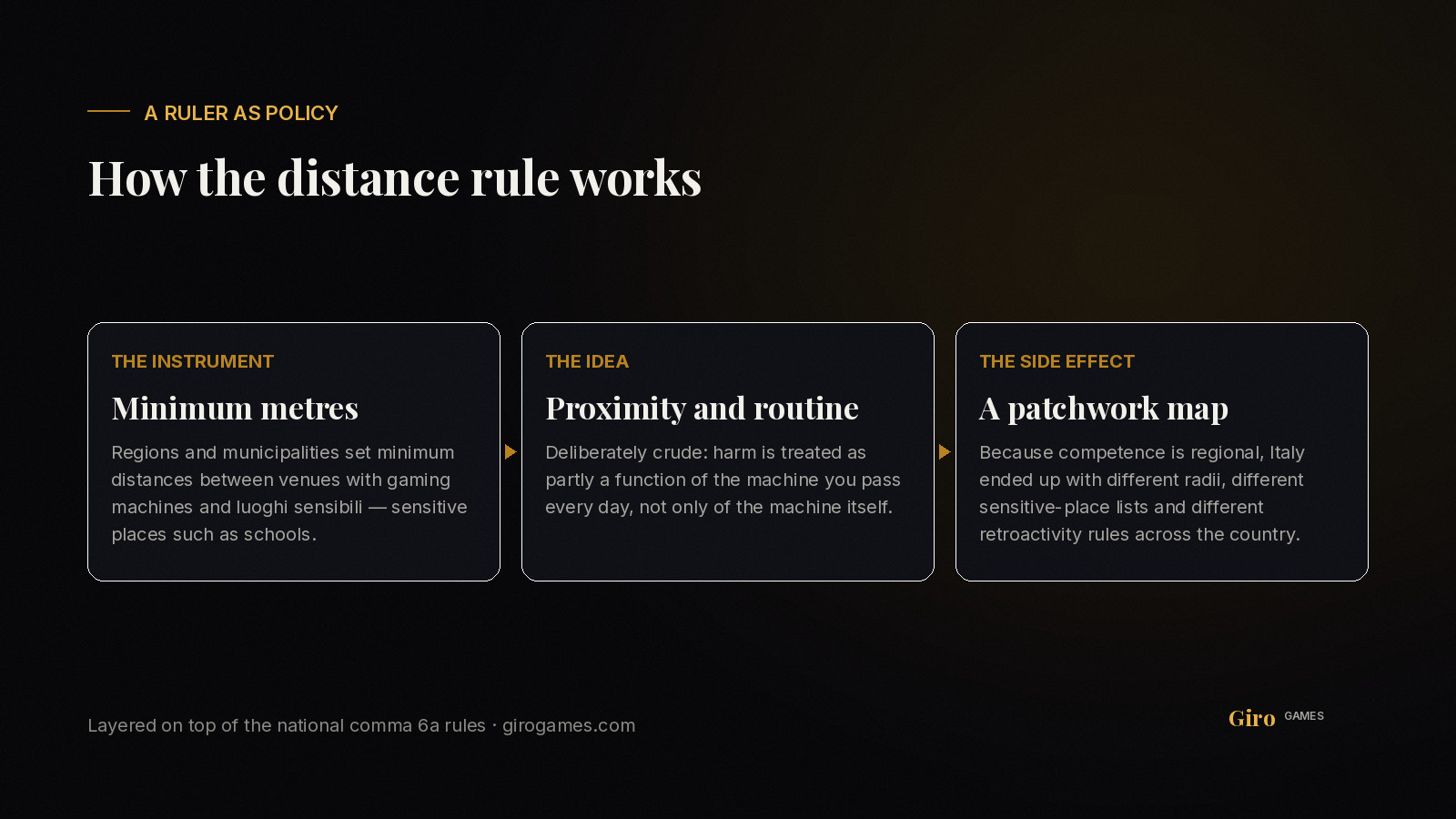
Italian regions and municipalities, exercising local competence over public health and territory, began setting minimum distances between venues offering gaming machines and so-called luoghi sensibili: sensitive places. Schools. Churches. Youth centres. Hospitals and clinics. Depending on the region, the radius has been set at figures in the hundreds of metres — enough that in a dense historic Italian town, the permitted zone can shrink to almost nothing.
The consequences were immediate and geographic. Whole categories of venue — bars with AWP cabinets, gaming arcades — found themselves non-compliant not because of anything they did, but because of what stood nearby. Where rules applied retroactively, existing businesses faced closure. Trade associations described the effect on operators in stark terms; regional governments pointed to evidence that the measure was working as a harm-reduction tool. Some regions have since softened the radius or made it non-retroactive, and Italy has been rewriting the land-based rulebook again.
Why distance is a serious idea
It sounds crude, and it is deliberately crude. The distanziometro treats gambling harm as partly a function of proximity and routine: the machine you pass every day on the way to collect your children is a different object from the one you must drive to. That is the same insight Finland arrived at from the opposite direction, having discovered what happens when machines live in supermarkets.
Distance rules also do something that stake limits cannot. A stake cap governs the intensity of an encounter; a distance rule governs whether the encounter happens at all. Regulators reach for it precisely when they suspect that the problem is not the individual spin but the ambient availability of spinning.
The fragmentation problem
Because the distanziometro is regional, Italy ended up with a patchwork: different radii, different sensitive-place lists, different retroactivity rules across the country, layered on top of national rules that already define what a comma 6a machine may pay and how fast it may run. Operators navigate a map rather than a rulebook, and the current national reform effort is in large part an attempt to reconcile that patchwork.
What it means for people who make games
A studio never sees the distanziometro directly — we ship math and art, not premises. But it belongs in any honest picture of what regulation of this industry actually looks like. The rules that shape gambling are not only about RTP and volatility; they are about geography, opening hours, the distance from a primary school gate. At Giro Games we work in the online segment, where the equivalent questions are about access, identification and limits rather than metres — but the underlying regulatory instinct is identical.
Sources: Piedmont: new gaming law, reduced and non-retroactive distance meter, JAMMA (Italian); Piedmont gambling report on the distance meter.
18+. Play responsibly.