Giro Games
 €12.50 an Hour: Belgium Regulates the Speed of Losing
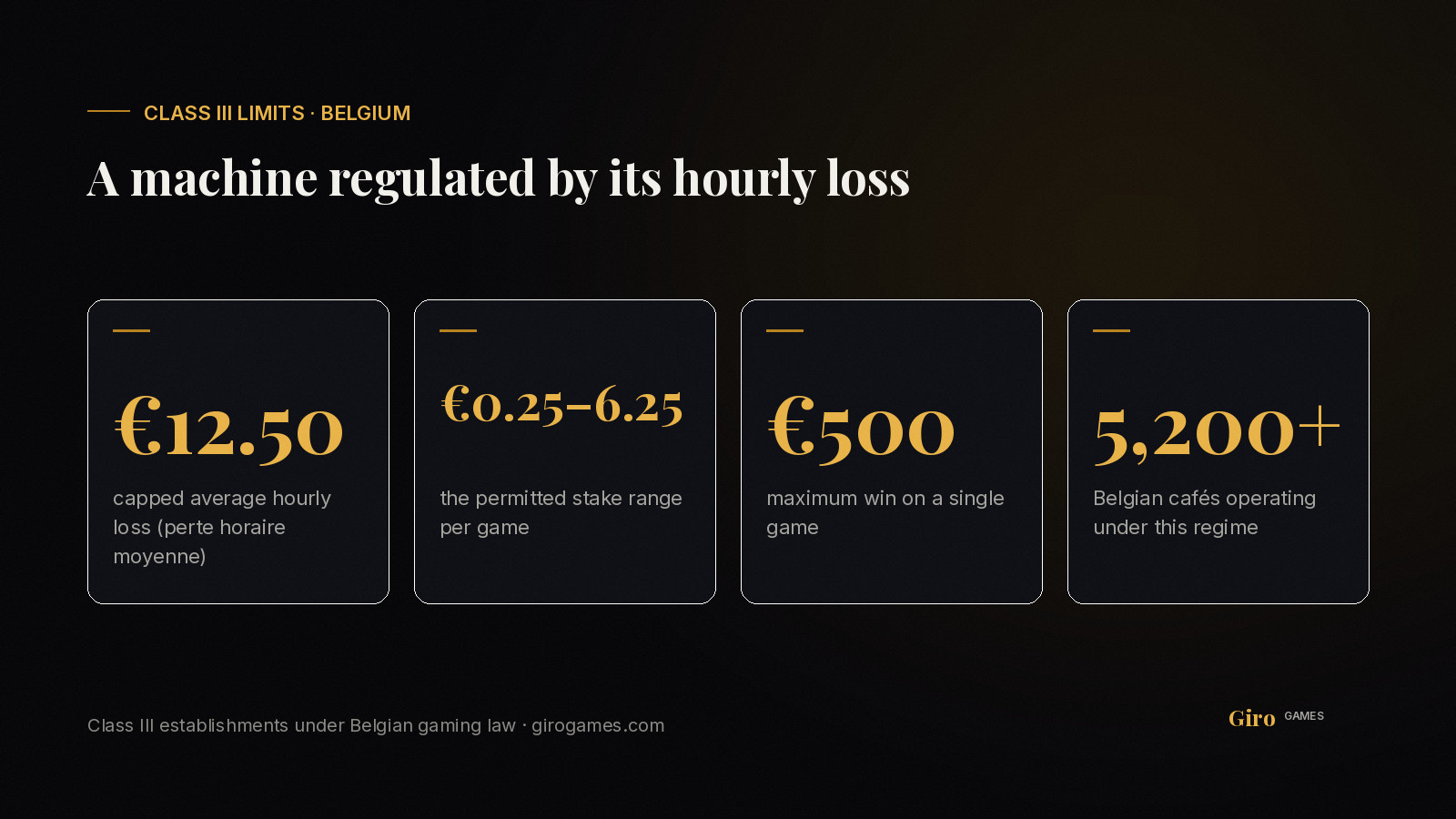
Most gambling regulation limits the stake. Belgium limits the speed. In Belgian cafés — Class III establishments under the country’s gaming law — the machines are governed by a figure called the perte horaire moyenne: the average hourly loss, capped at €12.50. Not the bet. Not the jackpot. The rate at which a player’s money is expected to disappear.
The rules of the Belgian café machine
A Class III venue — a bar or café, licensed under a licence C — may host a maximum of two machines, and only of specific types: the Belgian bingo and the one-ball. Stakes run from €0.25 to €6.25, wins cannot exceed €500 per game, and players must be at least 21 following the age-limit change effective 1 September 2024 (Belgian government announcement). As of the early 2020s, more than 5,200 Belgian cafés operated under this regime.
The Belgian “bingo” is not the paper-and-caller game the word suggests elsewhere. It descends from the electro-mechanical bingo pinballs of the mid-20th century — cabinets by Belgian makers such as Wimi, where the player shoots balls onto a playfield grid and pays to improve odds, shift lines and hold features. Belgium industrialised that format and kept it alive long after it vanished from other markets. There are collectors today restoring 1970s Belgian bingo machines, and the modern cabinet in a Brussels café is a direct descendant.
Why hourly loss is a smarter metric than it sounds
Two machines can have identical RTP and identical maximum bets and still separate a player from their money at wildly different rates, because the third variable is spin speed. A game that resolves in two seconds takes roughly twice the money per hour of one that takes four, all else equal. Stake caps alone therefore regulate very little; a fast machine with a small stake can outpace a slow machine with a large one.
By legislating expected loss per hour, Belgium bundles stake, RTP and speed into a single enforceable number — an approach that has quietly influenced how other European regulators think about machine harm. Italy reaches for the same target from a different direction with its mandatory four-second minimum game duration, and Germany does it with mandatory pauses and time-based loss caps in its Technische Richtlinie. Three countries, three mechanisms, one shared insight: the clock is the real regulator.
What a designer learns from a loss-rate cap
Design under an hourly-loss cap changes the objective function. You cannot buy excitement with volatility alone, because volatility that arrives faster costs you compliance headroom. What is left is craft: better anticipation, better feature pacing, better reasons to keep watching a screen that is deliberately not allowed to move very fast.
At Giro Games we build online RNG slots rather than café cabinets, but the Belgian metric is a good sanity check on any design. When we tune a high-volatility title like Midas Golden Era, the questions that matter most are the same ones Belgium wrote into law: how fast does this game move, and does the player feel that speed?
Source: Aide aux joueurs — Les jeux de hasard et la loi (French, Belgium).
Belgium: 21+. Play responsibly.