Giro Games
 Why There Is No Casino in Paris
France has more casinos than almost any country in Europe. Paris has none. Not because of an oversight, but because of a rule written into French gambling law that treated the capital as a place to be protected from itself — and it took until the 21st century for anything resembling a casino to appear inside the city at all.
The distance rule
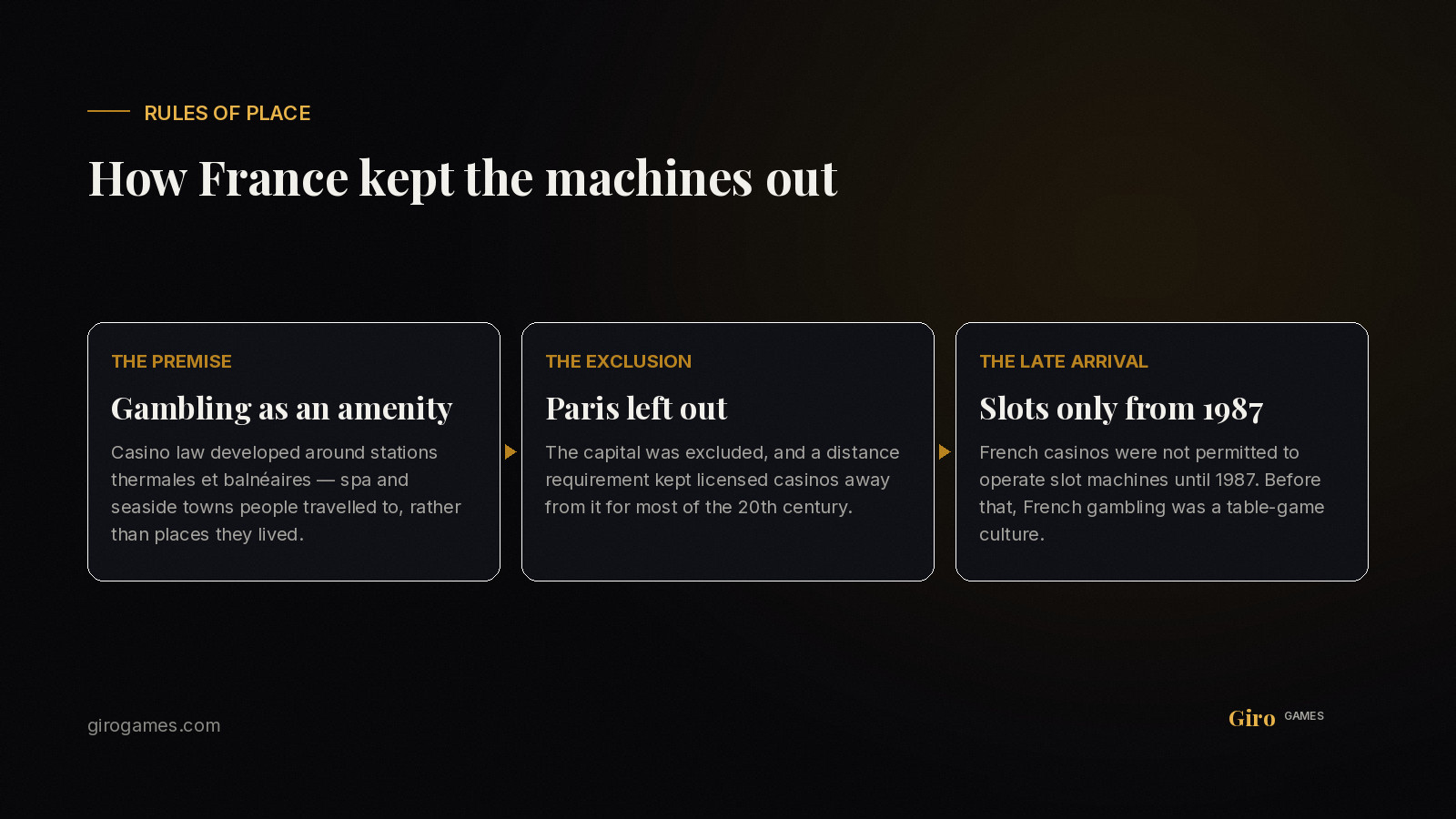
French casino law developed around spa towns and seaside resorts: gambling was permitted as an amenity of stations thermales et balnéaires, places people travelled to. Paris was excluded, and a distance requirement kept licensed casinos away from the capital. The logic was of its time — gambling was tolerable as a holiday indulgence for visitors, not as a daily fixture for a metropolitan population.
Paris instead developed cercles de jeux, private gaming clubs with a long and frequently scandalous history, later replaced by a newer generation of licensed clubs de jeux under a reform designed to bring the sector under proper control. Even these have had a turbulent time, with closures and licence changes making news. But a full casino in Paris in the sense that Nice, Cannes or Deauville have one still does not exist.
The slot machine arrived late
Here is the detail that surprises people who assume France was always a machine market: French casinos were not permitted to operate slot machines until 1987. Before that, French gambling was a table-game culture — roulette, banque, chemin de fer — with the machine treated as a vulgar import. Legalisation transformed casino economics almost overnight; within a few years the machines were generating the overwhelming majority of French casino revenue, as they do nearly everywhere they are allowed.
That late start makes France a natural experiment in what happens when a mature table-game industry meets the slot. The answer, consistently across markets, is that the machine wins on volume — not because it is better entertainment, but because it scales without staff, seats more players per square metre and never needs a dealer.
What the Paris exception really preserved
Cities are the densest possible distribution channel for gambling, which is exactly why so many jurisdictions have carved out capital-city exceptions or distance requirements of one kind or another. Italy’s regional distanziometro rules do the same work with a measuring tape; Czech municipalities did it by local ban. France simply drew its line early and kept it.
The result is a country where a tourist can find a casino in almost any resort and none at all in the city where a third of the nation’s visitors land. Whether that has protected anyone is genuinely arguable — Paris is not short of ways to gamble. What it has protected is a particular idea of what a capital should look like.
The studio angle
Rules of place do not travel to the online lobby, and that is precisely what makes the online era different in kind rather than degree: the distance from the player to the game is now zero everywhere. At Giro Games we build for that reality — original slots licensed to regulated operators, where the meaningful controls are account-level rather than geographic.
Sources: Why there is no casino in Paris, Sortiraparis; The story of gambling clubs in Paris.
18+. Play responsibly.