Giro Games
 Sixty Years Illegal, Then Everywhere: The Spanish Tragaperras
The Spanish bar slot — the tragaperras, literally the “coin swallower” — is such a fixture of Spanish daily life that it is easy to assume it was always there. It was not. Spain spent more than half a century with gambling formally prohibited, and the machine arrived only when the country’s politics changed.
The long prohibition
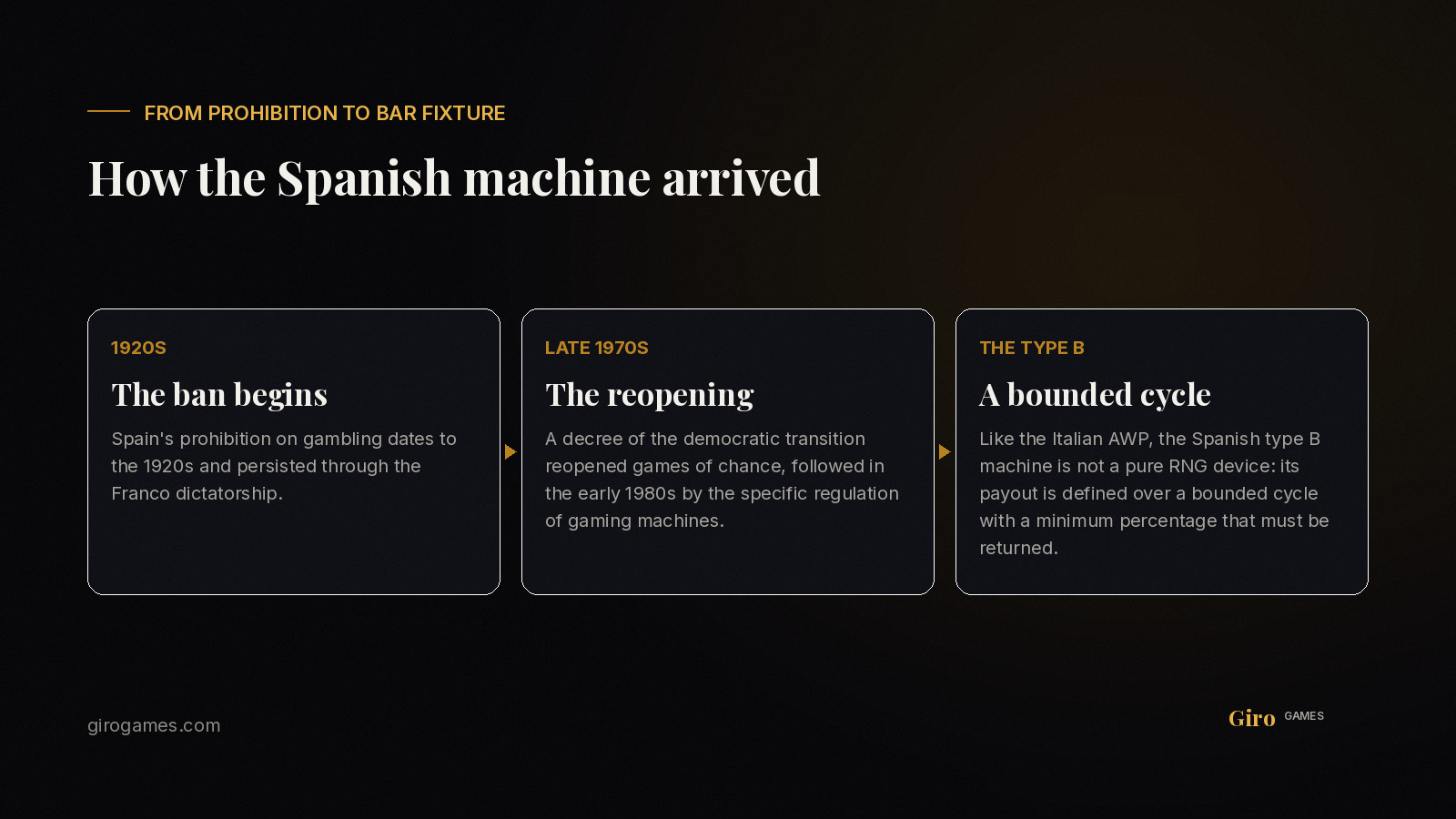
Spain’s gambling ban dates to the 1920s and persisted through the Franco dictatorship. Legalisation came with the democratic transition: the late-1970s decree that reopened games of chance, followed in the early 1980s by the specific regulation of gaming machines. What happened next was one of the fastest machine rollouts in European history — a country with a bar on every corner and a newly legal product designed for exactly that setting.
The Spanish machine took a distinctive form: the máquina tipo B, the recreational-with-prize machine, sitting in ordinary cafés and bars rather than in casinos, with modest stakes and a legally defined payout obligation.
The type B machine and its promise
Like the Italian AWP, the Spanish type B machine is not a pure RNG device in the western online sense. Its payout is defined over a bounded cycle of plays, with a minimum percentage that must be returned — the reason Spanish players talk about a machine being cargada (loaded) and why bar regulars have always tracked how long a particular machine has gone without paying. The folklore has a mathematical basis, the same one that makes Italian comma 6a machines behave unlike an online slot.
Around that machine grew an entire sensory culture. The musiquita of the tragaperras — the short, unmistakable melodies bar machines played on win and on attract mode — is a genuine piece of Spanish popular memory, discussed in Spanish media as a shared soundtrack of the 1980s and 1990s rather than as a technical feature.
Sound as identity, not decoration
That is the part worth pausing on. In most gambling markets, machine audio is treated as a design detail. In Spain it became cultural shorthand: a specific sequence of notes that anyone who spent time in a Spanish bar can reproduce from memory decades later. The melody outlived the cabinets.
Modern slot audio design is far more sophisticated — adaptive layers, dynamic mixes, escalating stems tied to feature states. It is also, arguably, less memorable. The Spanish bar machine had one short loop and infinite repetition, and that constraint produced an earworm that entered the national soundtrack. Constraint tends to do that.
The lesson we take
Audio is not the garnish on a slot; it is often the part players carry out of the room. When Giro Games builds a title, sound is designed alongside the math rather than after it — every symbol, animation and cue produced in-house, which is why the studio’s games have a recognisable acoustic signature rather than a library one. The tragaperras made that argument forty years ago, one melody at a time.
Sources: El sonido de las tragaperras (Spanish); A general introduction to gambling law in Spain, Lexology.
18+. Play responsibly.