Giro Games
 Why Everyone in the Post-Soviet World Calls Slots “Gaminators”
In English, “slot machine” is a description. In much of the post-Soviet world, the everyday word is a brand: гаминатор — gaminator. It is the local Xerox, the local Hoover: a specific product that swallowed the entire category it belonged to.
The machine behind the word
Gaminator was the multi-game platform of the Austrian manufacturer Novomatic — a cabinet loaded with a fixed roster of games under one shell. When the post-Soviet gambling boom arrived in the 1990s and 2000s, these cabinets filled the halls of Moscow, Kyiv, Minsk and Almaty in enormous numbers. Book of Ra, Lucky Lady’s Charm, Sizzling Hot, Dolphin’s Pearl: for millions of players these were not “Novomatic titles,” they were simply what was inside the gaminator.
Novomatic’s German-market line, Novoline, and its Admiral branding travelled with it, which is why those words appear interchangeably in the same conversations. But it was gaminator that became the noun.
Why one cabinet dominated so completely
Timing and format. The multi-game cabinet was ideally suited to a market being built at speed: one machine, many games, simple servicing, an operator model that scaled into any room with electricity. The region industrialised its gambling in a decade, and it did so largely on a single hardware standard.
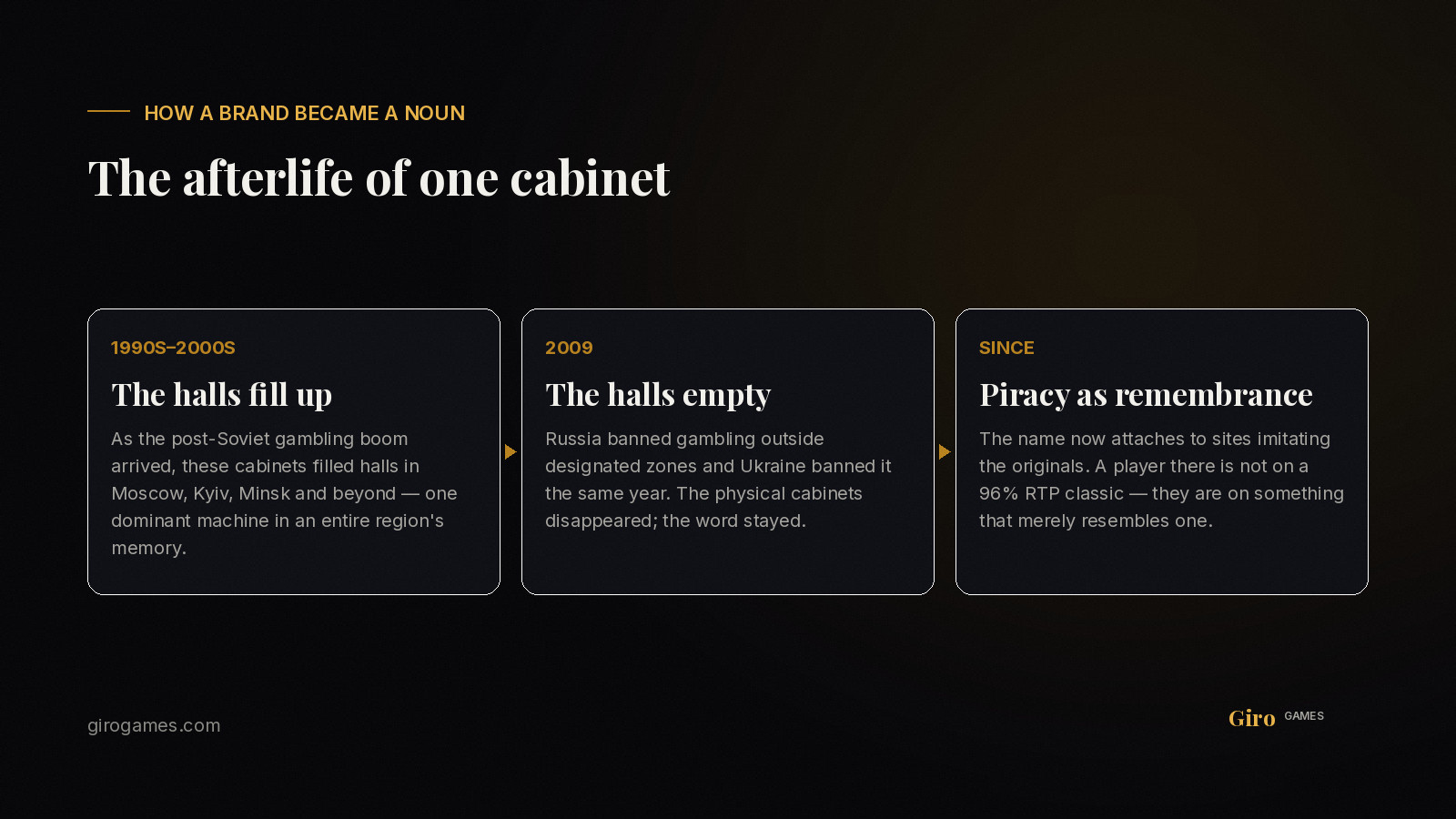
The linguistic consequence outlived the hardware. When Russia banned gambling outside designated zones in 2009 and Ukraine banned it the same year, the physical cabinets disappeared — but the word did not. It migrated online, where it now names an entire genre of nostalgic clone games, browser emulators and the endless grey-market sites that trade on the association.
The strange afterlife: piracy as remembrance
That afterlife is the part worth documenting honestly. Because the originals were so beloved and their legal availability so patchy after the bans, the region produced a vast ecosystem of counterfeit versions: unlicensed reimplementations of the classic titles, sold as “scripts” to unlicensed casinos. Industry monitors and player-protection sites have repeatedly caught operators serving pirated copies of Novomatic and other studios’ games — visually near-identical, mathematically unknown, certified by nobody.
This is the most concrete argument for provenance in slots that exists. A cloned game may look like the original down to the animations, but the one thing that cannot be cloned honestly is the certified math behind it. A player on such a site is not playing a 96% RTP classic; they are playing something that resembles it, with a payout nobody has verified.
Where a modern studio stands
Giro Games builds original slots — our own ideas, our own math models, our own characters — precisely because the alternative is the world described above. Original IP is not only a creative preference; it is the only version of this business where a player can know what they are actually playing. Our games are documented and licensed, which is why every title carries its RTP, volatility and max win in the open.
Sources: History of the Gaminator platform; Pirated Novomatic, Aristocrat and NetEnt slots found at an unlicensed casino, LCB; Are you playing fake slots?, Bigwinboard.
18+. Play responsibly.