Giro Games
 The Risk Ladder: Germany’s Gamble Feature as National Ritual
In most slot markets the gamble feature is an afterthought — a small “double or nothing” button that many players never press. In Germany it became the defining experience of an entire machine culture, with its own name, its own folklore and its own vocabulary: the Risikoleiter, the risk ladder.
How the ladder works
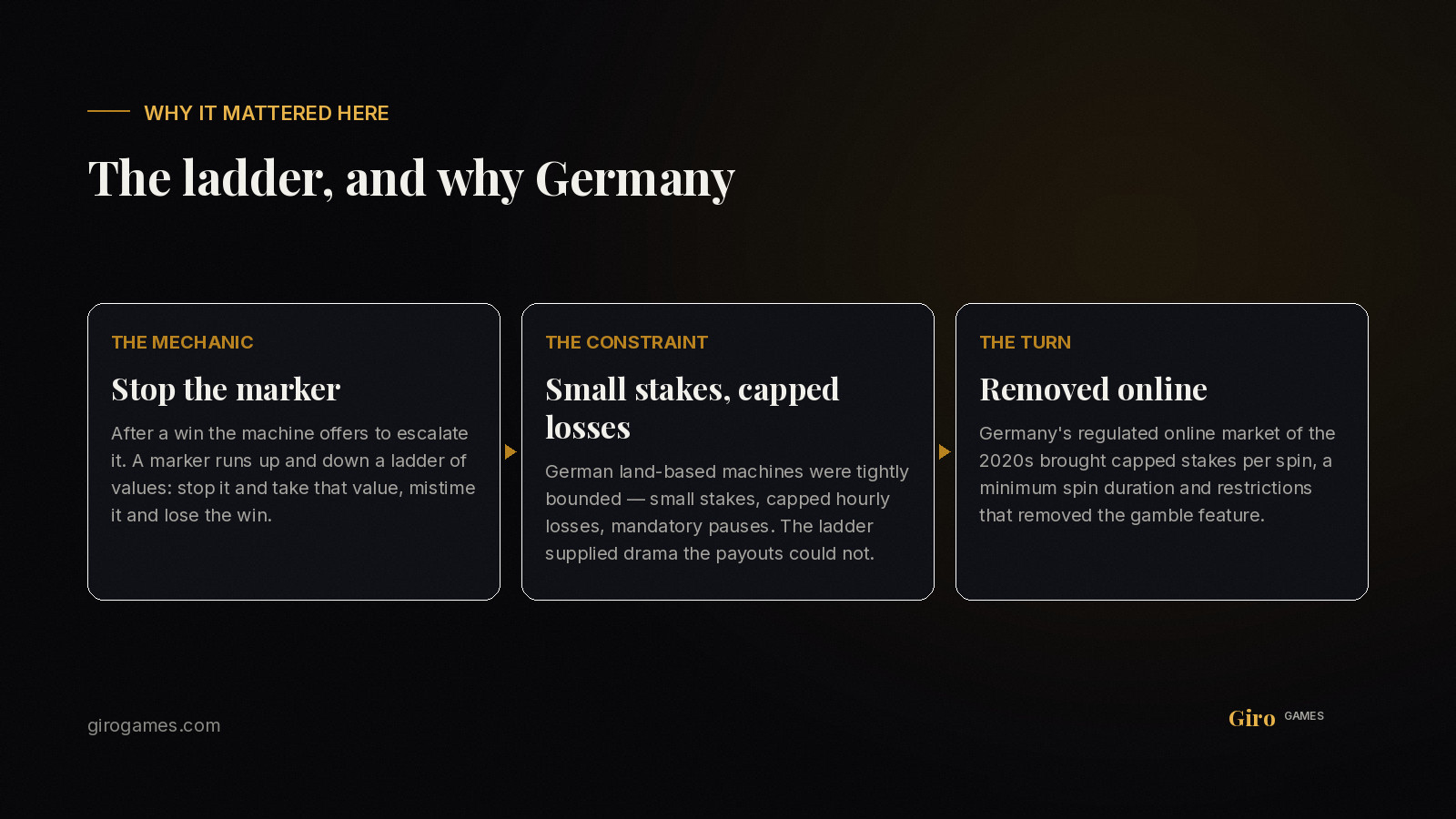
After a win, the German machine offers to escalate it. On the classic Merkur-style implementation the player faces a vertical ladder of values, with a marker running up and down. Stop it, and you take the value you stopped on; miss, and the win is gone. Other implementations use the card-colour gamble — red or black, double each time — but the ladder is the icon, tied above all to the Merkur brand and to titles like Blazing Star that German players discuss the way other markets discuss jackpots.
The ladder produced an entire genre of player lore about timing, rhythm and when to stop climbing. Whether any of it works is a separate question — the ladder is a random process, and the belief that it can be timed is the oldest kind of gambling folk theory. But the ritual of climbing, deciding, and taking or losing became the emotional core of the German slot experience in a way that spinning reels never quite were.
Why Germany in particular
Because German land-based machines were tightly constrained. Under the type-approval regime enforced through the national metrology institute, stakes were small, losses per hour were capped, and mandatory pauses interrupted play. In a format where the base game cannot deliver drama through big stakes, the gamble feature is the only place where a player gets to make a decision that visibly matters. Constraint pushed the excitement into the one interactive moment the rules allowed.
That is the same dynamic Belgium’s hourly-loss cap creates from a different direction, and it is a general law of regulated game design: restrict one axis of intensity and designers will find another.
The regulatory turn
When Germany built its regulated online market in the 2020s, the treaty rules were strict: capped stakes per spin, a mandatory minimum spin duration, and restrictions that removed familiar mechanics — the gamble feature among them. German online slots became, by design, slower and flatter than the machines their players grew up with. The industry press has since tracked the partial return of risk features to German online products as rules were revisited, which tells you how central the mechanic is to that market’s identity.
Meanwhile the same period saw a documented rise in illegal machines in Germany, and the ladder’s absence from the legal product is part of that story — the classic problem of channelisation, where a licensed offer that omits the thing players want pushes some of them elsewhere.
What we take from the ladder
The Risikoleiter is a masterclass in a narrow point: players value agency disproportionately. A slot spin is passive; the ladder is a decision. Even when the expected value is unchanged, the felt experience is completely different. At Giro Games we build features where the player’s choices are genuine — like the escalating tiers of Midas Golden Era, where progression is something you watch yourself earn rather than something the reels hand you.
Sources: Gamble-Funktion in Slots (German); Germany raises online slot stake limits, iGB.
18+. Play responsibly.