Giro Games
 A Slot Machine Called Jack: How Sweden Put Gambling in Every Pub
Say “Jack Vegas” to a Swede over thirty and they will picture a specific cabinet: the terminal in the corner of a restaurant or pub, glowing quietly next to the coat rack. Jack Vegas was never a single game. It was the state’s machine network — the brand under which Svenska Spel operated video slot terminals in licensed hospitality venues across Sweden, alongside its sibling Miss Vegas in bingo halls.
Before the state: Cherry, 1963
The Swedish restaurant slot did not begin with the monopoly. It began commercially — the company later known as Cherry traces its origins to 1963 and built its early business precisely on placing gaming machines in Swedish restaurants, long before it became an online gambling group. That commercial era shaped the venue culture: machines belonged in places where adults ate and drank, operated by a company that serviced them route-style.
When Sweden consolidated gambling under state control, the restaurant machine survived the transition and acquired a state uniform. Jack Vegas terminals were governed by the constraints of their setting: modest stakes, limits per venue, and a hospitality licence as the gatekeeper — you could only host the machines if you were the kind of establishment the state considered appropriate.
The politics of a machine in a bar
Because the operator was the state, every argument about the machines became an argument about the state. Svenska Spel at times lobbied for more Jack Vegas terminals — a public monopoly asking to expand its gambling footprint, which produced exactly the political friction one would expect. Critics pointed out the obvious tension in a government simultaneously running harm-prevention campaigns and a machine network in pubs.
Sweden ultimately reorganised its market in 2019 with a licensing system that let private operators in under regulation, ending the simple monopoly framing. The restaurant terminals persisted, but the debate about them had permanently changed: they were no longer “the state’s machines” in a market with no alternative.
The venue is part of the game
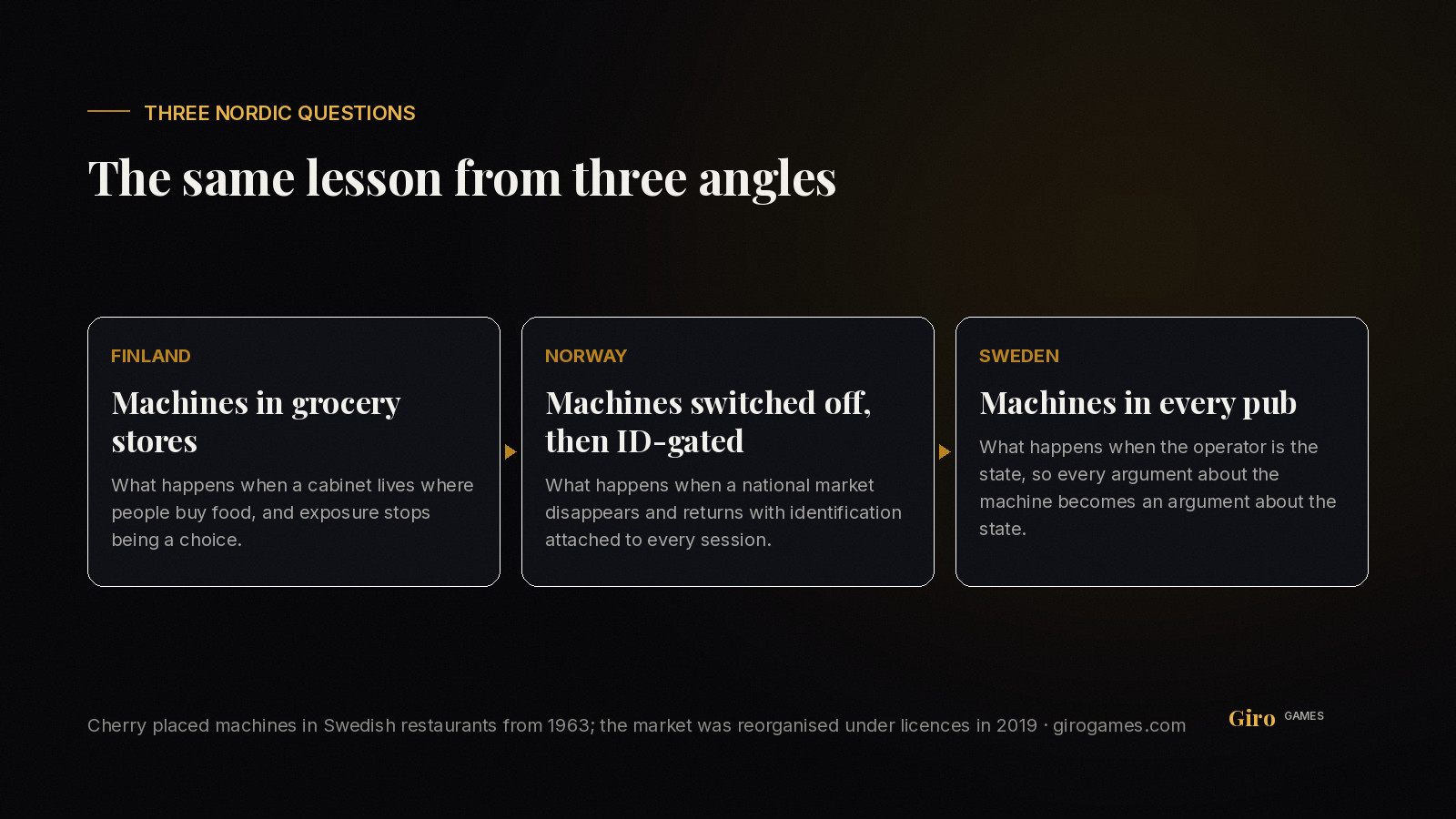
The Nordic countries keep teaching the same lesson from different angles. Finland asked what happens when machines live in grocery stores. Norway asked what happens when they disappear and return with ID cards. Sweden’s Jack Vegas asked a narrower question: what does it mean that the machine is in a restaurant — a social space, with staff, with other people at other tables, with a natural end to the evening?
That environment does real work. A machine in a pub is embedded in a social occasion that has its own rhythm; the same machine in a dedicated arcade is the occasion. Designers rarely control placement, but placement quietly rewrites the session length, the stake sizes and the emotional register of everything they design.
Why a studio pays attention
At Giro Games we ship to online lobbies, where the “venue” is a phone at an unpredictable hour. The Swedish story is a reminder that this is not a neutral change — it removes the closing time, the bartender, the friend at the table. Designing well for that context means building games with natural stopping points rather than infinite ones, a principle we apply from the first math sketch of a title through to release.
Sources: Vegas (spelautomat), Swedish Wikipedia; Svenska Spel calls for more Jack Vegas gambling machines, Sveriges Radio; Cherry — casino experience since 1963.
18+. Play responsibly.