Giro Games
 Slots That Owe You Money: Inside Italy’s Cycle-Based AWP Machines
Walk into almost any Italian bar or tabaccheria and you will see them in the corner: the newslot, known in law as comma 6a AWP machines (Amusement With Prize, article 110, comma 6a of the Italian public security code). They look like ordinary video slots. Mathematically, they are a different species — and almost nothing has been written about them in English.
A slot with a legal debt to its players
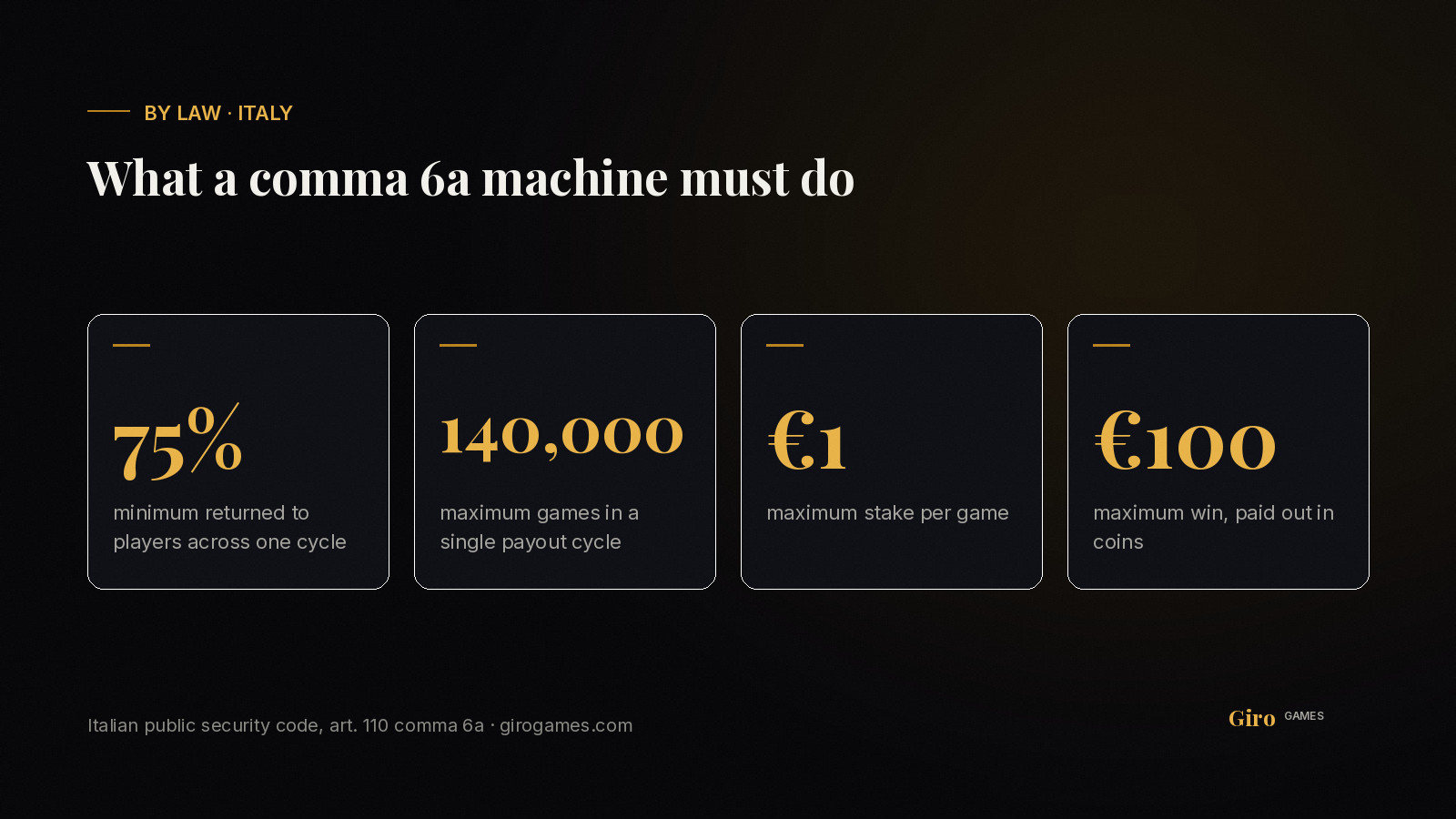
An online video slot’s RTP — say 96% — is a long-run statistical expectation, not a promise about a particular session. Italian comma 6a AWP machines have a different regulatory history: older rules specified a minimum 75% payout over a cycle of no more than 140,000 games. That 75% figure is historical. From 1 January 2020, the statutory minimum payout was set at 65% for AWP and 83% for VLT, under the 2020 budget provisions. A regulatory payout requirement is not a debt owed to the next individual player.
A bounded-cycle payout requirement and a long-run RTP describe different ways of specifying a machine. Neither the headline percentage nor a run of losses tells a bystander the machine’s complete state, its remaining cycle or the conditional probability of the next result. The folklore of watching a machine “fill up” should therefore not be presented as a proven winning method.
The numbers that define a comma 6a machine
The format is tightly boxed in by regulation: a maximum bet of €1 per game, a maximum win of €100 paid out in coins, a minimum game duration of 4 seconds, and mandatory connection to the state telematic network run by the customs and monopolies agency (ADM). Every legal machine carries a nulla osta — an individual state clearance document — and reports its numbers to the network.
Compare that with the machines in dedicated Italian VLT halls (comma 6b): €10 maximum bets, €5,000 maximum wins, server-based games whose statutory minimum payout was set at 83% from 1 January 2020. Same country, same law, two entirely different gambling machines — a split we cover in a separate piece.
Why cycle math died everywhere else
Cycle-based or “compensated” machines are part of European gaming-machine history, including British AWP traditions. Understanding a particular machine requires its actual model and operating rules. A legal payout minimum does not, by itself, establish an observable player advantage late in an apparent losing streak. Online slots also need to be read by their specific RTP version, bet mode and feature state; a familiar title does not guarantee identical parameters in every implementation.
Italy kept the cycle model for its bar machines anyway — partly regulatory inertia, partly because the format’s low ceilings (€1 stake, €100 prize) keep the stakes of any “advantage” small. The result is a living museum of an older philosophy of slot design, sitting next to espresso machines from Turin to Palermo.
What a studio takes from this
At Giro Games we build RNG slots the modern way — an independent math model, a published RTP baseline of 96%+, simulated across millions of spins before release (the process is documented in how an original slot game is made). But the Italian cycle machine is a useful mirror: it shows that RTP is not one idea but a family of ideas — a promise over infinity, or a debt with a deadline. Knowing which one a machine makes is the single most useful piece of slot literacy a player can have.
Sources: Sistema Gioco Italia — apparecchi da intrattenimento (Italian); Amusement with prize.
18+. This article describes how regulated gambling machines work; it is not encouragement to play. Play responsibly.