Giro Games
 Fun Games: The German Machines That Were Legally Not Gambling
Somewhere in the history of every gambling market there is a category of machine that exists purely because of a definition. Germany’s was called Fun Games — cabinets that occupied German arcades in the late 1990s and early 2000s, legally classified as amusement devices because they paid out no money at all. They paid in points.
The loophole, precisely
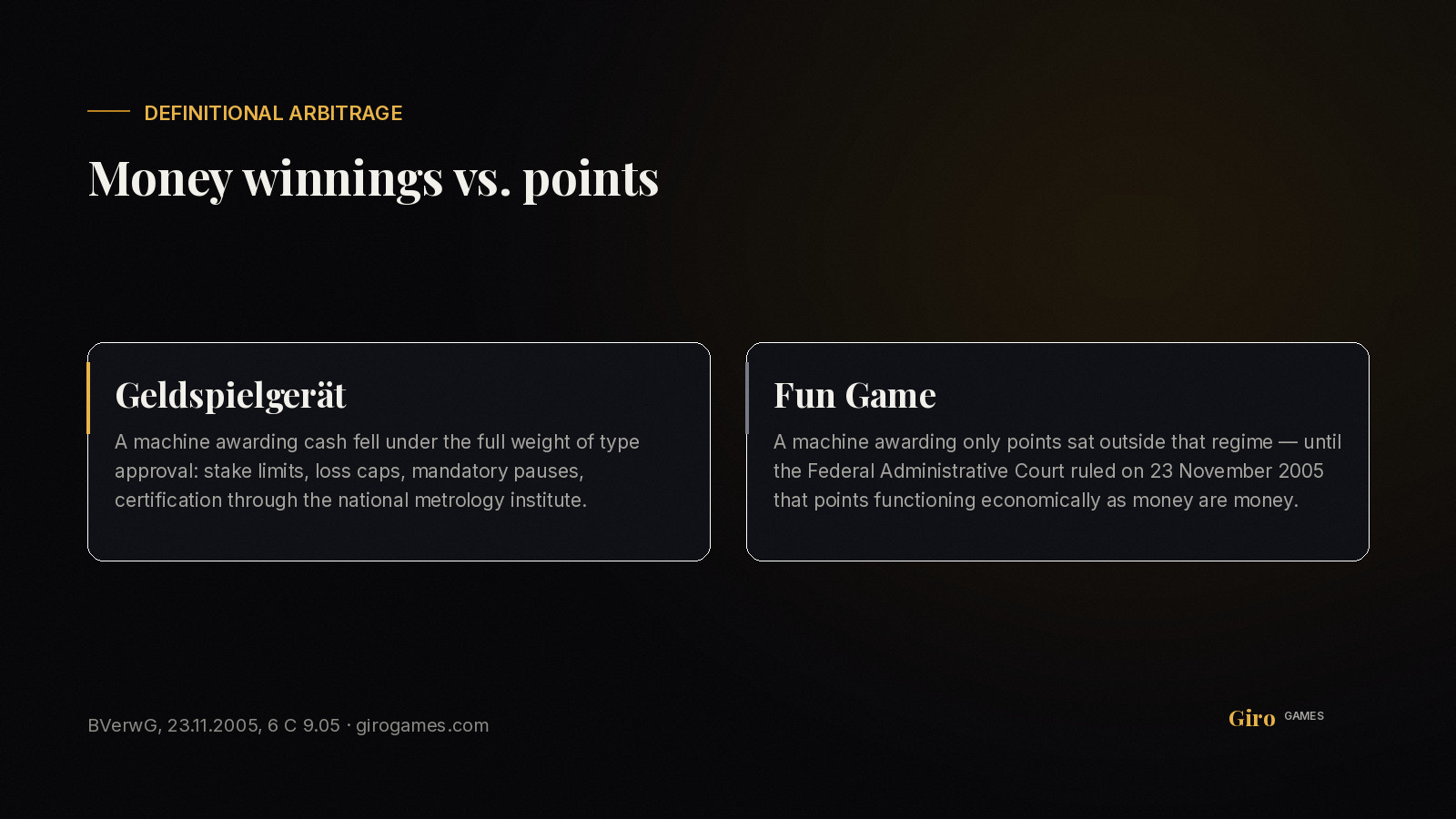
German law drew its line around Geldgewinn — money winnings. A machine that awarded cash was a Geldspielgerät, subject to the full weight of type approval, stake limits, loss caps and mandatory pauses. A machine that awarded only points to continue playing was an amusement device with almost none of those constraints.
Manufacturers built accordingly. Fun Games ran at speeds no approved cash machine could touch, accumulated large point balances, and offered stakes per game far beyond the legal cash-machine limits — all lawful, because no money came out of the cabinet. What happened to the points afterwards was, in the tidy legal fiction, not the machine’s business.
The trade association’s own account of the period notes how central the format became to German arcades before the reckoning.
The 2005 ruling
On 23 November 2005 the Bundesverwaltungsgericht, Germany’s Federal Administrative Court, ruled on Fun Games and effectively closed the category. The reasoning cut through the formalism: a machine whose points function economically as money, in a setting where they are treated as money, is a gambling machine regardless of what leaves the coin tray. The devices were withdrawn.
The pattern this belongs to
Fun Games is one instance of the single most persistent phenomenon in gaming-machine regulation: the definitional arbitrage machine. Every market has produced one. The Netherlands pre-empted it by creating a legal category for skill machines that may only pay in free play. Japan built an entire national industry on the fact that pachinko halls do not pay cash directly. Korea’s Sea Story scandal grew out of gift certificates. Germany itself is watching the newest generation of the same idea today, as authorities raid venues running unlicensed points-based machines that echo the Fun Games logic almost exactly.
The lesson regulators keep relearning is that a definition based on the form of the payout — cash, points, tokens, certificates, prizes — will always be gamed. Definitions based on the economic function of the payout are much harder to route around, which is precisely what the 2005 court said.
Why we find this interesting as builders
Because it clarifies what a slot machine actually is. Not reels, not symbols, not a cabinet: a device that converts money into a random outcome with an expected loss. Everything else is presentation. At Giro Games we build games that are unambiguously what they are — licensed slots with published RTP, running on operator platforms under a regulator’s eye — and the Fun Games episode is a useful reminder of why that clarity is worth more than any loophole.
Sources: Verbot von Fun Games — BVerwG, 23.11.2005, 6 C 9.05 (German); VDAI — Fun Games (German).
18+. Play responsibly.