Giro Games
 Kapchagay: The Kazakh Town That Was Ordered to Become Las Vegas
In 2007 Kazakhstan removed gambling from its cities. Casinos and slot halls, which had spread through Almaty and other urban centres after independence, were given a choice: close, or relocate to one of two designated zones. One was near Lake Kapchagay, north of Almaty. The other was in the Shchuchinsk district of Akmola Region, around the inland Borovoye resort area — not on the Caspian coast (official account of the 2007 framework). Overnight, a modest lakeside town became the country’s appointed gambling capital.
The zone model
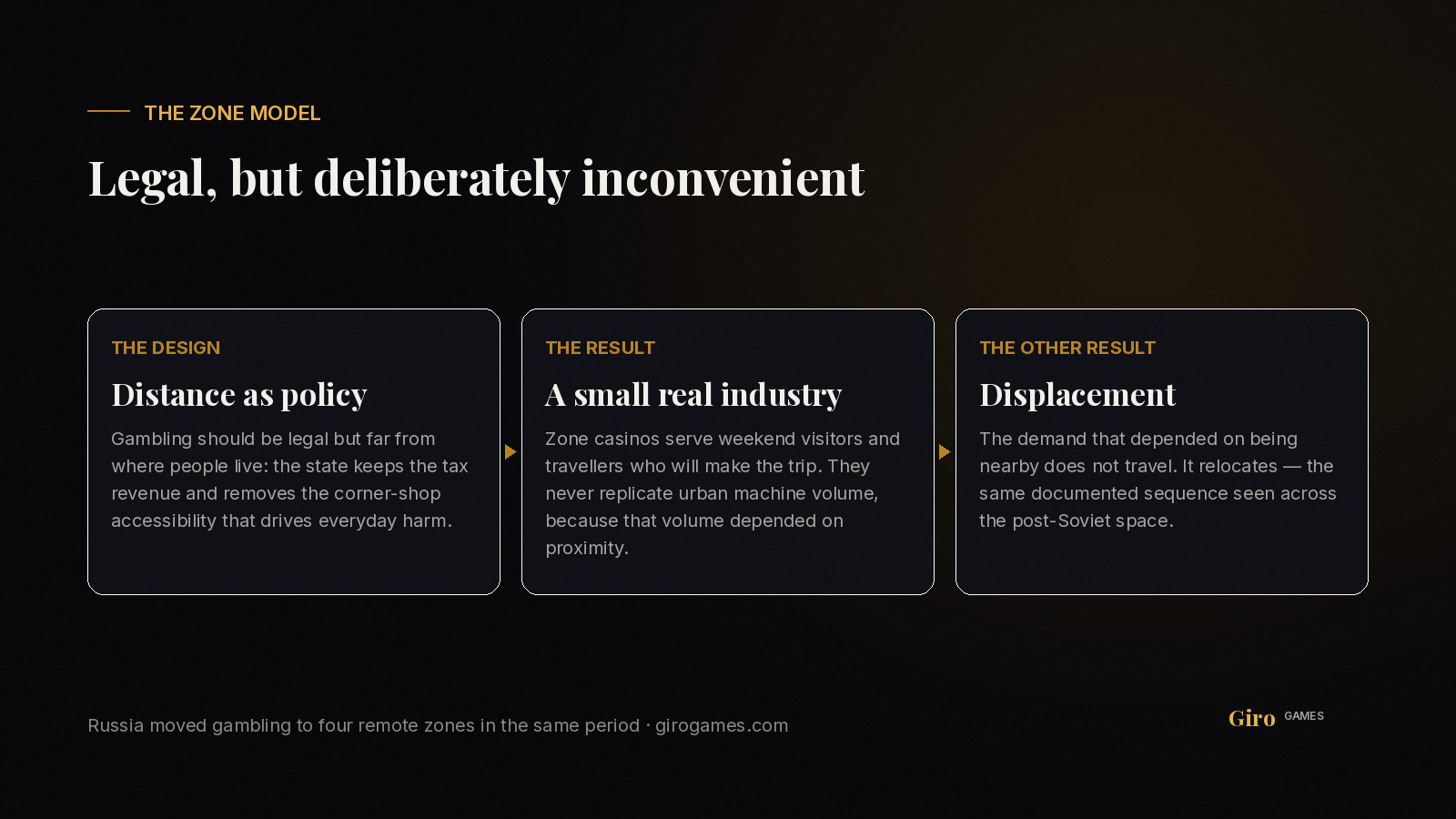
The idea was not original to Kazakhstan. Russia did the same thing in the same period, banishing gambling to four remote zones. The logic in both cases was identical: gambling should be legal but inconvenient. Put the casinos far from where people live, and you keep the tax revenue while removing the corner-shop accessibility that drives everyday harm.
Kapchagay had geography on its side — a reservoir, beaches, existing tourist traffic from Almaty about an hour away. Casinos were built. The town acquired the inevitable nickname of Kazakh Vegas, and the inevitable coverage pointing out how far it fell short of the comparison.
What the zone model actually produces
Two well-documented effects, both visible across the post-Soviet space.
First, a real but small legal industry. Zone casinos serve weekend visitors and high-rollers who will travel. They do not replicate the volume of urban machine gambling, because that volume depended on proximity.
Second, displacement rather than elimination. The demand that used to be served by city slot halls does not evaporate when the halls are relocated hundreds of kilometres away. In Russia it moved into illegal venues disguised as lottery clubs, internet cafés and payment-terminal rooms, and into offshore online sites. Kazakhstan’s own experience has included persistent concern about gambling harm and pressure for stricter regulation, with recent research examining the social costs of gambling in the country.
Distance as a policy instrument, again
The zone model is the maximal version of an idea that appears everywhere in machine regulation: put space between the player and the game. Italy measures it in hundreds of metres from a school. France drew a ring around Paris. Kazakhstan and Russia drew it around entire cities.
The consistent finding is that distance works on casual participation — the person who would have played because the machine was there — and works far less well on committed demand, which travels or finds a substitute. Whether that trade is worth it is a genuine policy question. What it is not is a solution that makes the market disappear.
Why the online era changed the argument
Because distance became unenforceable. The entire premise of zoning is that access has a geography, and a licensed online market has none. Every country that built its policy on physical separation eventually had to rebuild it around identification, licensing and payment controls instead.
That is the environment Giro Games works in: original slots supplied to licensed operators, where the meaningful boundaries are account-level rather than territorial. Kapchagay is a monument to the older idea — a town assigned a purpose by a map that stopped mattering.
Sources: High rollers hit Kaz Vegas, Eurasianet; The social costs of gambling in Central Asia, Central Asian Survey.
18+. Play responsibly.