Giro Games
 Sea Story: How a Fish Arcade Game Shook a Government
In 2006 South Korea was consumed by a scandal named after an arcade game about fish. Bada Iyagi — Sea Story — was a colourful, gentle-looking cabinet that had spread through Korean arcades in enormous numbers. It was also, in economic substance, a slot machine, and the country woke up to that fact all at once.
The gift-certificate machine
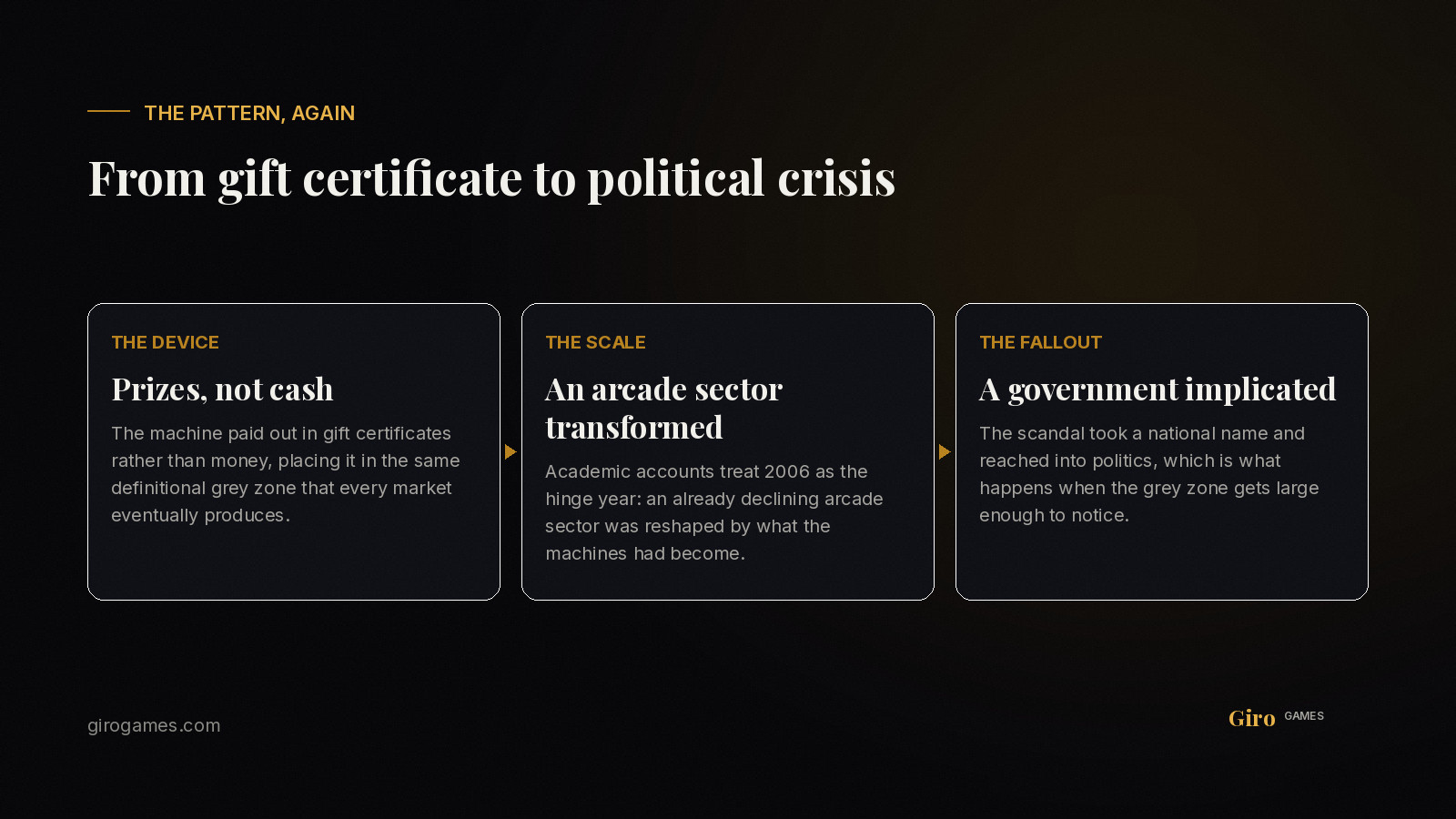
The mechanism was the now-familiar definitional workaround. Korean law restricted gambling, but arcade machines could award gift certificates as prizes. Certificates could then be exchanged for cash at nearby shops at a discount — an entire parallel economy of small exchange counters that existed for no other purpose.
The game itself was engineered for the arrangement: high turnover, jackpot events, and a payout structure that made it a gambling device with a maritime skin. The scale was extraordinary. Sea Story cabinets and their imitators were everywhere, and the money flowing through them was on the order of a national industry.
Why it became political
Because approval had come through the state rating body, and because the sums were vast, questions about how the game was certified and who benefited reached the highest levels of Korean politics. The affair triggered prosecutions, a parliamentary storm, and a public apology from the prime minister. Academic accounts of the Korean arcade treat 2006 as the hinge: the year the arcade sector, already declining, was effectively destroyed as a mainstream leisure category.
The regulatory response was structural. Korea overhauled its game rating institutions and hardened the rules around anything resembling gambling in games — a stance whose descendants can be seen today in Korean scrutiny of loot boxes, NFTs and other borderline mechanics in video games.
The pattern, again
Sea Story belongs to the same family as Germany’s Fun Games and every other machine that gambles while claiming not to. What makes the Korean case distinctive is the collateral damage: the reaction did not merely close a loophole, it delegitimised an entire form of public entertainment. Korean arcades never recovered, and a generation grew up associating the arcade itself with the scandal.
That is the risk that borderline products carry for everyone around them. The industry harmed by a gambling scandal is frequently not the gambling industry — it is the adjacent, innocent category that shared a roof with it.
Why this matters to a slot studio
Because our sector benefits enormously from the boundary being clean. When a slot is licensed, rated, certified and unmistakably itself, everyone can reason about it — regulators, operators, players. When products blur the line, the eventual correction is indiscriminate.
Giro Games builds original slots for regulated operators, and states plainly what they are on every game page: the RTP, the volatility, the maximum win. Sea Story is a case study in the cost of the opposite approach.
Sources: Before the Bang: The Rise, Fall and Legacy of the Korean Arcade, Game Studies; South Korean PM apologizes for video game controversy, Taipei Times.
18+. Play responsibly.