Giro Games
 Medal Games: Japan’s Slot Machines Where Winning Buys You Nothing
Go up a floor in a large Japanese game centre and you find a room that looks exactly like a casino: banks of slot cabinets, coin pushers, a horse-racing table game with a crowd around it, the sound of metal on metal. Then you notice what is missing. There is no cashier. The medals you are playing with cannot be exchanged for money, goods, or anything else. Win a thousand of them and you have won a thousand medals.
How the medal economy works
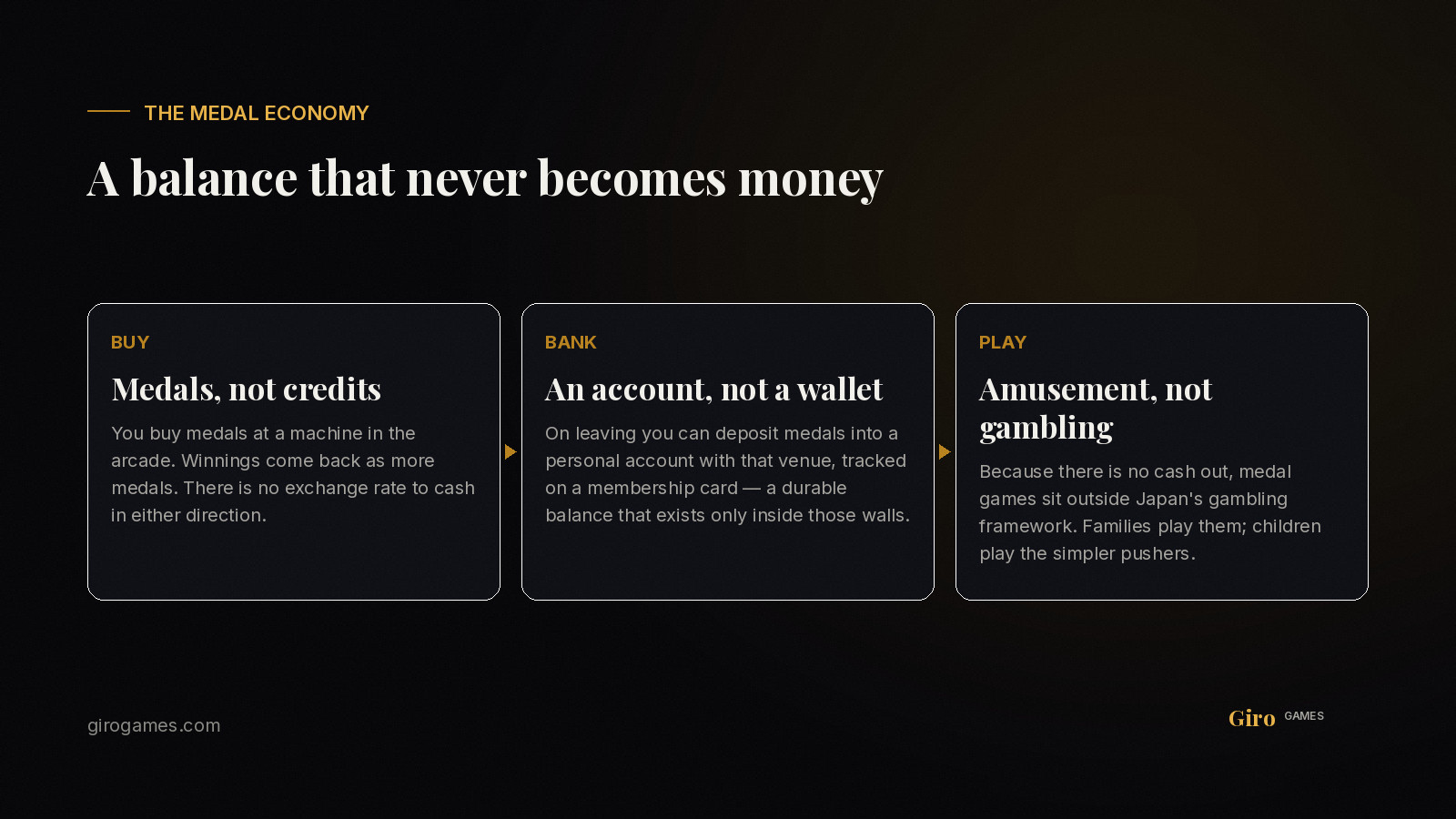
You buy medals at a machine. You play. Winnings come back as more medals. When you leave, you either abandon them or — and this is the elegant part — you deposit them into a personal account with the arcade, tracked on a membership card, to be withdrawn on your next visit. The medals become a durable, non-monetary balance that exists only within that venue.
Because there is no cash out, medal games sit outside Japan’s gambling framework. They are amusement. Families play them. Children play the simpler pushers. Retirees spend afternoons on the horse-racing games. Sega’s own arcade guides list medal titles alongside crane games and rhythm cabinets as ordinary attractions.
What this proves about slot machines
Something genuinely surprising: a large fraction of the appeal survives the removal of money entirely.
Strip out cash and you lose the financial stakes, the possibility of profit, the entire economic layer. What remains is the loop — bet, anticipate, resolve, escalate — plus the accumulation of a balance you can watch grow, plus the social texture of a room full of people doing the same thing. Japanese arcades demonstrate at scale, over decades, that this residue is enough to sustain an industry.
Western social casino apps discovered the same thing later, monetising virtual chips that likewise buy nothing. Japan got there first with physical metal, and it did it in family venues rather than on phones.
The design implication is uncomfortable and useful
If the loop works without money, then the money is not what makes the loop work — it is what makes it dangerous. That reframing is clarifying for anyone building slots. The craft of the format is anticipation, pacing, escalation and feedback. The cash layer sits on top and amplifies everything, including the harm.
It follows that the quality of a slot as entertainment should be judged by whether it would still be interesting with medals — and that a game which is only exciting because real money is at risk is not a good game, it is a bad game attached to a risk.
Our version of that test
Giro Games builds real-money slots for licensed operators; we are not pretending otherwise. But the medal-game question is one we ask internally about every feature: would this still be fun if the stakes were tokens? When the answer is no, the feature is not carrying its weight — it is borrowing excitement from the player’s wallet rather than earning it through design.
Sources: Medal game; Sega game centre guide — token games.
18+. Play responsibly.