Giro Games
 The Dutch Three-Machine Rule: Where a Slot Legally Stops Being a Slot
Ask a Dutch café owner what stands in the corner of the room and you will not hear the word “slot machine.” You will hear one of three precise legal terms — and the difference between them decides whether the cabinet is a gambling device, an amusement, or a fairground toy. The Netherlands has quietly built one of the clearest taxonomies of gaming machines in the world, and it barely exists in English.
Three species of machine
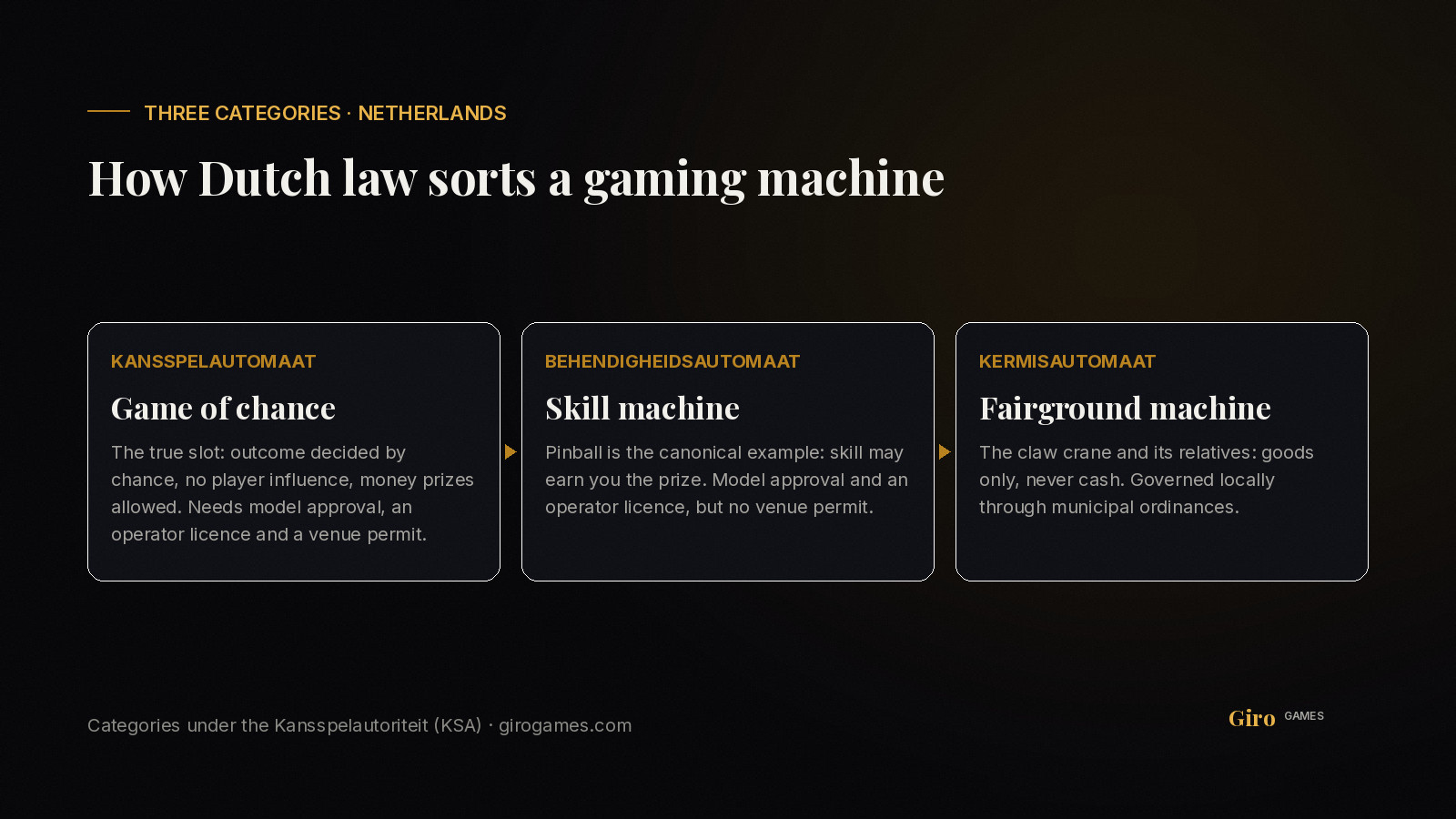
The Dutch regulator, the Kansspelautoriteit (KSA), recognises three categories:
1. Kansspelautomaat — the true slot: outcome decided by chance, the player has no influence, money prizes allowed. It requires three separate permissions: model approval for the cabinet itself, an operating licence for whoever runs it, and a location permit tied to the venue.
2. Behendigheidsautomaat — the “skill machine,” with pinball as the canonical example. The player’s skill influences the outcome, and crucially, the machine may award only extended play or free games — never cash. Model approval and an operator licence are still needed, but no location permit.
3. Kermisautomaat — the fairground machine, like a claw crane: no cash at all, only goods or vouchers, capped at forty times the wager. The national regulator steps back entirely; municipalities govern them through local ordinances.
The interesting part: the boundary
Every gaming machine designer eventually learns that the most contested space in the industry is not the jackpot — it is the boundary between chance and skill. In the Dutch system that boundary is written into hardware categories. A cabinet that pays money must be a kansspelautomaat, and a kansspelautomaat may live only where the law lets it: the famous distinction between hoogdrempelige venues (high-threshold — cafés and bars whose primary business is drink, adults’ territory) and laagdrempelige ones (low-threshold — snack bars, cafeterias), where cash machines are forbidden precisely because teenagers wander in for chips.
The genius of the three-way split is that it removes the grey zone that plagues other markets. In countries with a two-way split (gambling vs. amusement), manufacturers spend decades probing the line with “skill slots” and point machines — Germany’s Fun Games saga, which we cover separately, is exactly that story. The Dutch answer was to give skill its own regulated box with a hard rule: skill may earn you more play, never money.
The gokkast in culture
None of this stopped the Dutch from loving their gokkasten — the cash slots of the corner café, with their own folklore, nicknames and a generation of players who learned the machines’ club meters and dubbel-up gambles by heart. The Netherlands even exported the affection: Dutch-language slot guides and gokkast emulator communities were documenting machine behaviour online years before “slot review” became an English-language content genre.
Why this matters to a slot studio
For a studio like Giro Games, the Dutch taxonomy is a reminder that “what is a slot?” is a legal question before it is a design question. The same math model can be a licensed gambling product in one room and an illegal machine two streets away, purely because of what the cabinet pays and where it stands. When we design an original slot, the design brief begins with jurisdiction — the same discipline that decides how an original slot game is made from GDD to release.
Source: Kansspelautoriteit — Speelautomaten (Dutch).
18+. Play responsibly.