Giro Games
 Rainbow Means Jackpot: The Color Grammar of Japanese Machines
Somewhere in a Japanese hall right now, a machine has just flashed its reel lamp red, and the player’s pulse has jumped — not because anything has been won yet, but because red sits high on a ladder every Japanese player knows by heart. At the top of that ladder is the rainbow. When a Japanese machine goes rainbow, the win is essentially promised.
The ladder of colors
Japanese machine design centres on enshutsu (演出) — staged performances that fill the seconds between “the outcome has been decided” and “the outcome is revealed.” Under Japanese regulation the result of a spin is fixed the instant it starts; everything the player then watches is theatre. Over three decades, that theatre standardised into a color grammar used across manufacturers:
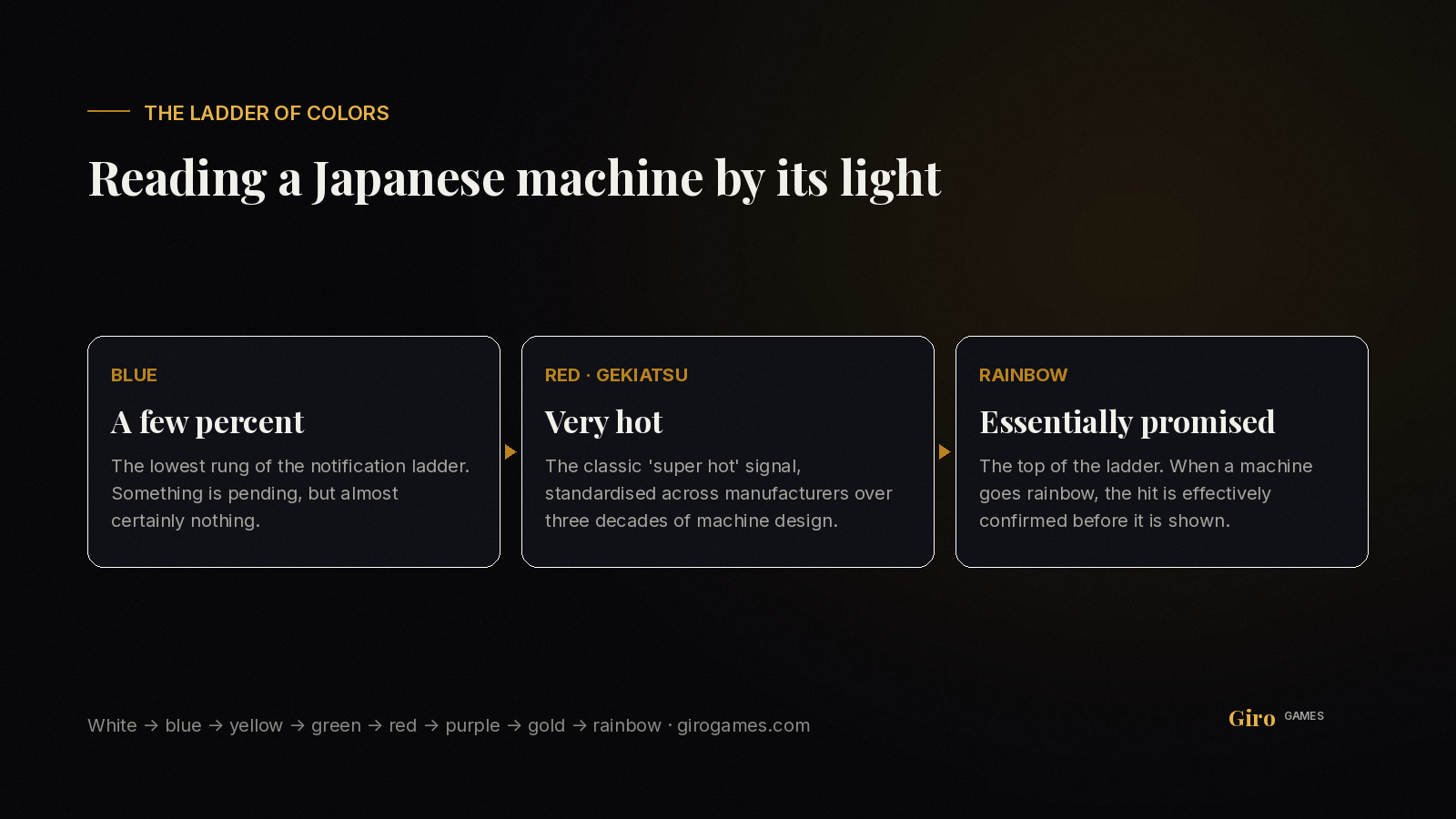
White → blue → yellow/orange → green → red → purple/zebra → gold → rainbow.
Each step signals a higher probability that the pending outcome is a hit. A blue notification lamp might mean a few percent; red is the classic gekiatsu (激アツ — “blazing hot”) tier where players stop breathing; gold means prepare yourself; and rainbow (虹, niji) is by convention a guaranteed or near-guaranteed jackpot — a kakutei signal. Players discuss these odds tables the way sports fans discuss statistics, and Japanese wikis publish per-machine breakdowns of exactly what each color implies on each title.
Why build a language of near-wins?
Because Japanese machines cannot use money as drama. Payout structures are tightly regulated, sessions are long, and the daily arc of a machine matters more than any single result. So designers moved the drama from the wallet to the senses: color ladders, button vibrations, screen cut-ins, character battles whose outcome mirrors the hidden dice roll. The machine tells you a story about a decision it has already made.
The color grammar even leaked into wider Japanese pop culture — anime series stage entire scenes around a machine climbing the ladder toward rainbow, confident the audience needs no explanation.
The contrast with western slots
Western video slots use anticipation too — teased scatters, near-miss reel stops, rising win meters — but nothing as codified. There is no cross-manufacturer agreement that a certain color means a certain probability band. Japan effectively built an industry-wide UX standard for hope, precise enough that veteran players can price a flash of purple in percentage points.
There is a deep design lesson in that precision. Anticipation systems work when they are honest: Japanese color tiers stay meaningful because the implied probabilities are real, tracked, and published by the community. The moment a red flash stopped meaning roughly what it promises, the grammar would collapse.
What we borrow from it
At Giro Games we design western-style RNG slots, not pachislot — but the Japanese lesson shapes how we think about feature pacing in our own titles: every teaser animation in a bonus like the golden-touch tiers of Midas Golden Era is tuned so that what the player feels matches what the math is actually doing. Theatre, but honest theatre.
Background reading (Japanese): per-machine enshutsu odds tables on community wikis; (English, general): Pachinko — Wikipedia.
18+. Play responsibly.