Giro Games
 The Industry That Measures Itself: Japan’s DK-SIS Hall Data Network

Imagine if every casino in a country pooled its machine-by-machine performance data into a single benchmarking service, and every operator could see how their floor compared with the national average — by title, by day, by seat. In western gambling markets, that idea sounds impossible. In Japan it has a name and a vendor: DK-SIS, operated by Daikoku Denki.
What the system does
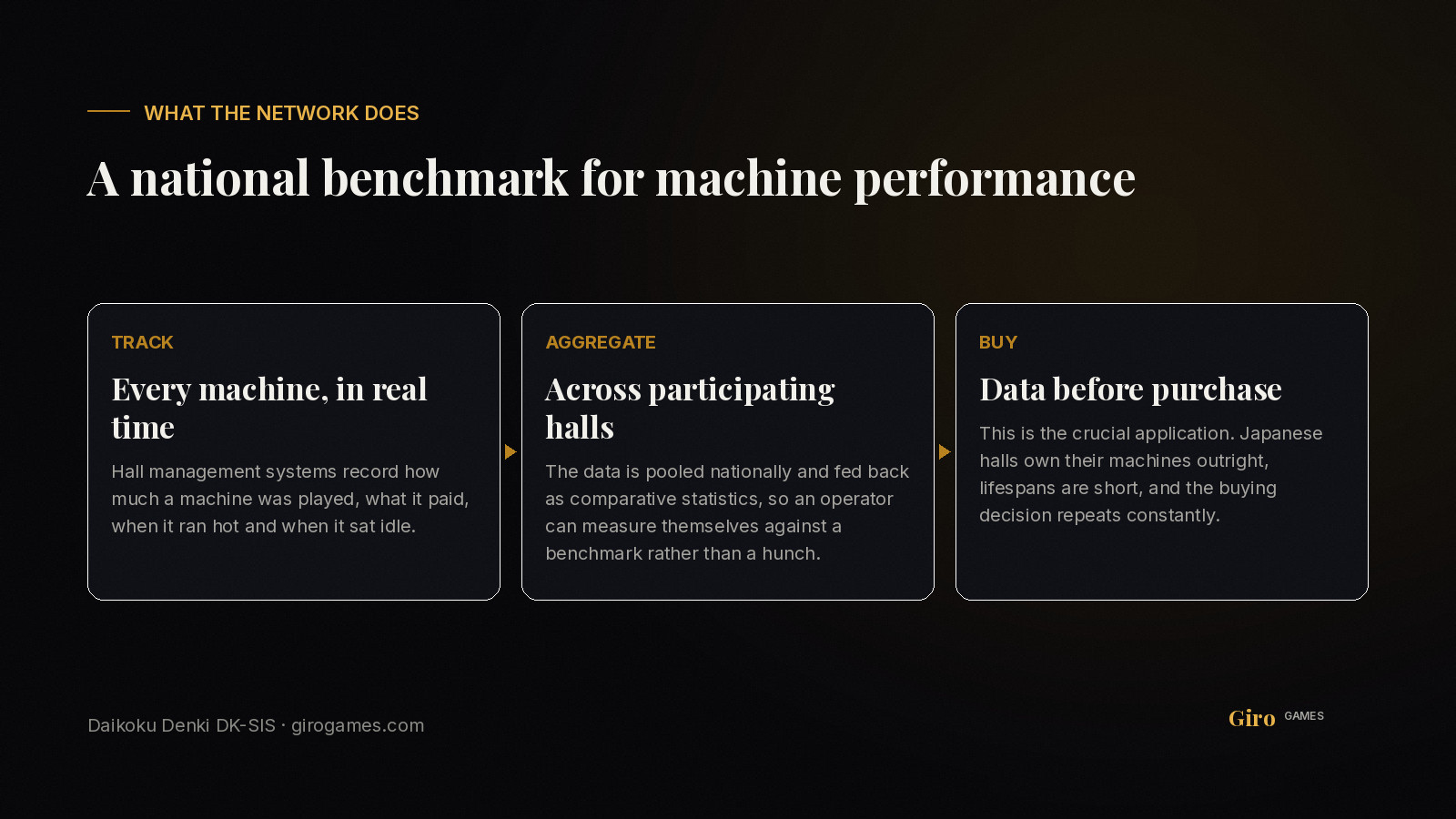
Japanese pachinko and pachislot halls run computerised hall-management systems that track every machine in real time: how much it was played, what it paid, when it ran hot and when it sat idle. DK-SIS aggregates that data from participating halls nationwide and feeds comparative statistics back to them, so an operator can measure their own performance against national benchmarks. Daikoku Denki describes it as the industry’s only such service system for management strategy, and offers halls the ability to compare specifications of upcoming machines before purchase.
Purchasing is the crucial application. A hall buying new cabinets is making a substantial capital decision, and DK-SIS turns it into an evidence-based one: how has this manufacturer’s previous title actually performed on floors like mine?
Why Japan built this and the West did not
Structural reasons. Japanese halls buy their machines outright, which makes purchase decisions high-stakes and data-hungry. Machine lifespans are short, driven by regulation and player appetite for novelty, so the buying decision repeats constantly. And the industry is dense, domestic, and served by a small number of technology suppliers who can plausibly aggregate it.
Western casino operators, by contrast, often lease or participate in revenue-share arrangements, operate across jurisdictions with different rules, and treat floor performance as competitive intelligence to be guarded rather than pooled. Suppliers hold their own analytics; regulators hold audit data; nobody has the full picture and nobody is incentivised to build it.
The visibility this creates
The consequence is a market with unusually good self-knowledge. Japanese industry commentary can discuss trends in machine utilisation and payout with a granularity that western trade press simply cannot match, because the underlying data exists in aggregated form. Players benefit indirectly too: an ecosystem of Japanese data sites publishes per-hall and per-machine histories, and the culture of reading machine data is mainstream rather than niche.
That transparency has a disciplining effect. A hall that deploys tight settings across the floor develops a reputation, and the data makes the reputation legible.
The online parallel — and the gap
Online slot studios sit on exactly this kind of data for their own games: session lengths, feature trigger rates, bet distributions, where players stop. The difference is that it stays inside each studio. There is no shared benchmark, no industry mirror, no way for a small studio to know whether its retention curve is normal.
At Giro Games we build our own math and instrument our own titles, so the internal picture is clear. What Japan demonstrates is how much more an industry understands about itself when that picture is shared — and how strange it is that a sector obsessed with numbers keeps so few of them in common.
Source: Daikoku Denki — DK-SIS.
18+. Play responsibly.