Giro Games
 The Kugishi: Japan’s Craftsmen Who Tuned Machines With a Hammer

A pachinko machine is a vertical pinball field studded with hundreds of small brass nails. Steel balls cascade down through them; where a ball ends up is decided by the geometry of that nail field. And for most of pachinko’s history, that geometry was not fixed at the factory. It was adjusted, by hand, by a specialist: the kugishi (釘師) — the nail craftsman.
The job
The kugishi worked after closing, moving along a row of machines with a hammer and a set of specialised tools, tapping individual nails a fraction of a degree. Widen a gap here and balls flow more readily into a scoring pocket; close one there and the same machine tightens. Multiply across hundreds of nails and dozens of machines and you have a hall whose entire payout landscape can be reshaped overnight.
This was skilled work in the full Japanese sense of the word — closer to the world of the shokunin, the master artisan, than to maintenance. A good kugishi could read a machine’s statistics and know which nails were responsible. The craft was learned by apprenticeship, guarded, and paid accordingly. Players, in turn, developed kugi-yomi: nail-reading, the practice of inspecting the field before choosing a seat, sighting down the rows to spot which machines had been opened up.
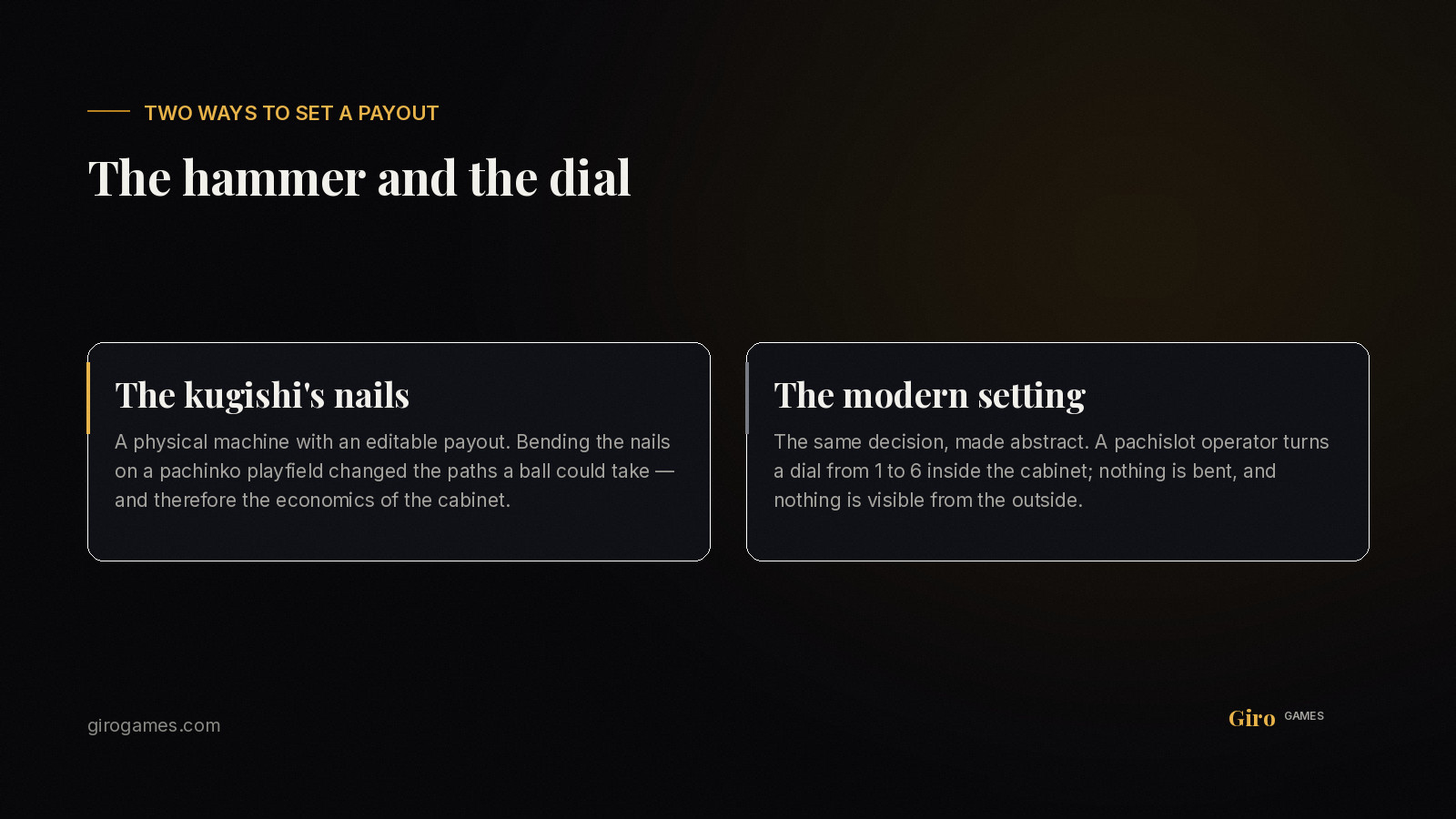
A physical machine with an editable payout
Step back and consider how strange this is against the western model. A Las Vegas slot’s payout lives in a certified program; changing it is a regulated event involving sealed chips and paperwork. A pachinko machine’s payout lived in metal, and could be edited nightly by a person with good hands and no software at all.
That created a completely different relationship between hall and player. The hall was not merely hosting machines; it was tuning them, and the player was reading the tuning. Japanese machine culture has kept that dynamic even as technology moved on — it is the physical ancestor of the settei system in pachislot, where the modern operator turns a dial from 1 to 6 instead of tapping a nail.
The craft under pressure
Regulation, digitalisation and industry consolidation have all pushed against the kugishi. Modern machines are more tightly specified and monitored, nail adjustment sits under regulatory scrutiny, and hall economics have squeezed the specialist roles. The trade has thinned dramatically. Japanese features on veteran parlour owners who still work their own nails read as portraits of a vanishing profession — because that is what they are.
Why a digital studio should care about a hammer
Because the kugishi represents something the industry lost when it went fully digital: a human hand in the loop, and a payout that a player could in principle see. Modern online slots are fairer, more consistent and more auditable — genuinely better on every measurable axis — but nothing about a certified RNG is visible to the naked eye.
That is precisely why studios owe players transparency to replace what visibility used to provide. At Giro Games that means published RTP, stated volatility and documented max win on every game page rather than buried in a help file. You cannot sight down the nails of a digital slot. You can read its numbers.
Sources: Pachinko parlor owner sticks to his nails, Tokyo Reporter; Pachinko.
18+. Play responsibly.