Giro Games
 The Casino of Europe Closes Its Hernas
For much of the post-1989 period, Czechia carried an unflattering nickname in European gambling circles: the casino of Europe. It was earned not by grand casinos but by the herna — the small, curtained, often windowless gambling bar that appeared in Czech towns in extraordinary numbers, frequently clustered near borders where German and Austrian visitors could reach them easily.
What a herna actually was
Not quite a bar, not quite an arcade. A herna combined cheap drink, long opening hours and a row of machines, in a format optimised for locals rather than tourists. The genre acquired a whole cultural signature in Czech life: the green or red neon sign, the discreet entrance, a specific reputation in the neighbourhoods where the density was highest. Guides written for visitors to Prague warned newcomers away from herna bars for reasons that had little to do with the machines themselves.
The scale was the point. Czechia’s permissive framework, weak municipal control in the early years, and a border geography that imported demand from stricter neighbours combined to produce a machine estate out of proportion to the country’s size.
How it ended
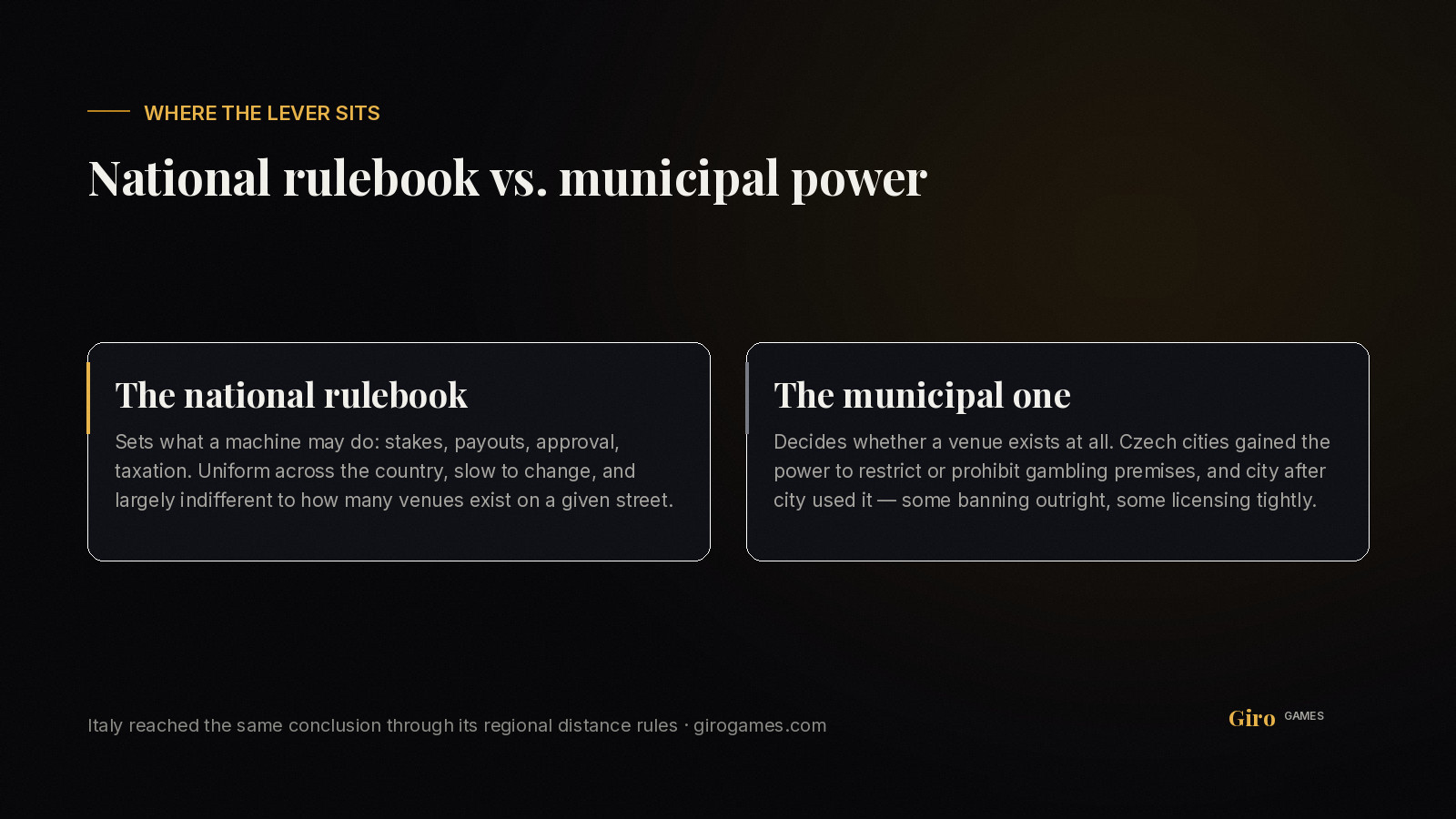
Not by a single national ban, but by devolution. Czech municipalities gained the power to restrict or prohibit gambling venues on their territory, and city after city used it — some banning machines outright, others licensing them into a handful of controlled locations. The map emptied gradually and then quickly. Reporting in recent years describes the herna as a vanishing species: shuttered venues, converted premises, a category of Czech public space that is passing out of existence.
What replaced it, predictably, was online. The Czech regulated online market grew as the physical one contracted — a substitution effect visible in almost every European market that squeezed its machine estate in the 2010s.
Local control as the decisive variable
The Czech case makes a strong argument that the most powerful lever in machine policy is not the national rulebook but the municipal one. Italy discovered the same thing through its regional distance rules. When a mayor can decide whether machines exist in the town at all, gambling policy stops being an abstraction debated in a capital and becomes a question decided at street level, by people who see the venues every day.
That produces uneven maps and legal disputes, but it also produces the fastest observable change of any instrument in the toolkit.
The studio reading
Land-based estates shrink; online catalogues grow. The industry’s centre of gravity has moved decisively toward the format Giro Games builds for — original online slots, licensed operator by operator. The herna story is a reminder of how recent that shift is, and how much of the modern online lobby is a descendant of rooms that no longer exist.
Source: Game over: Czechia no longer the ‘casino of Europe’, Radio Prague International.
18+. Play responsibly.