Giro Games
 Twenty Thousand Machines, Thirty Days: Hungary’s Overnight Ban
Regulatory change in gambling is usually slow: consultations, transition periods, grandfathering. Hungary in 2012 did the opposite. Parliament moved to prohibit gaming machines outside casinos, and the industry went from operating to illegal in a matter of weeks — an abruptness that turned a policy story into a decade of litigation.
What happened
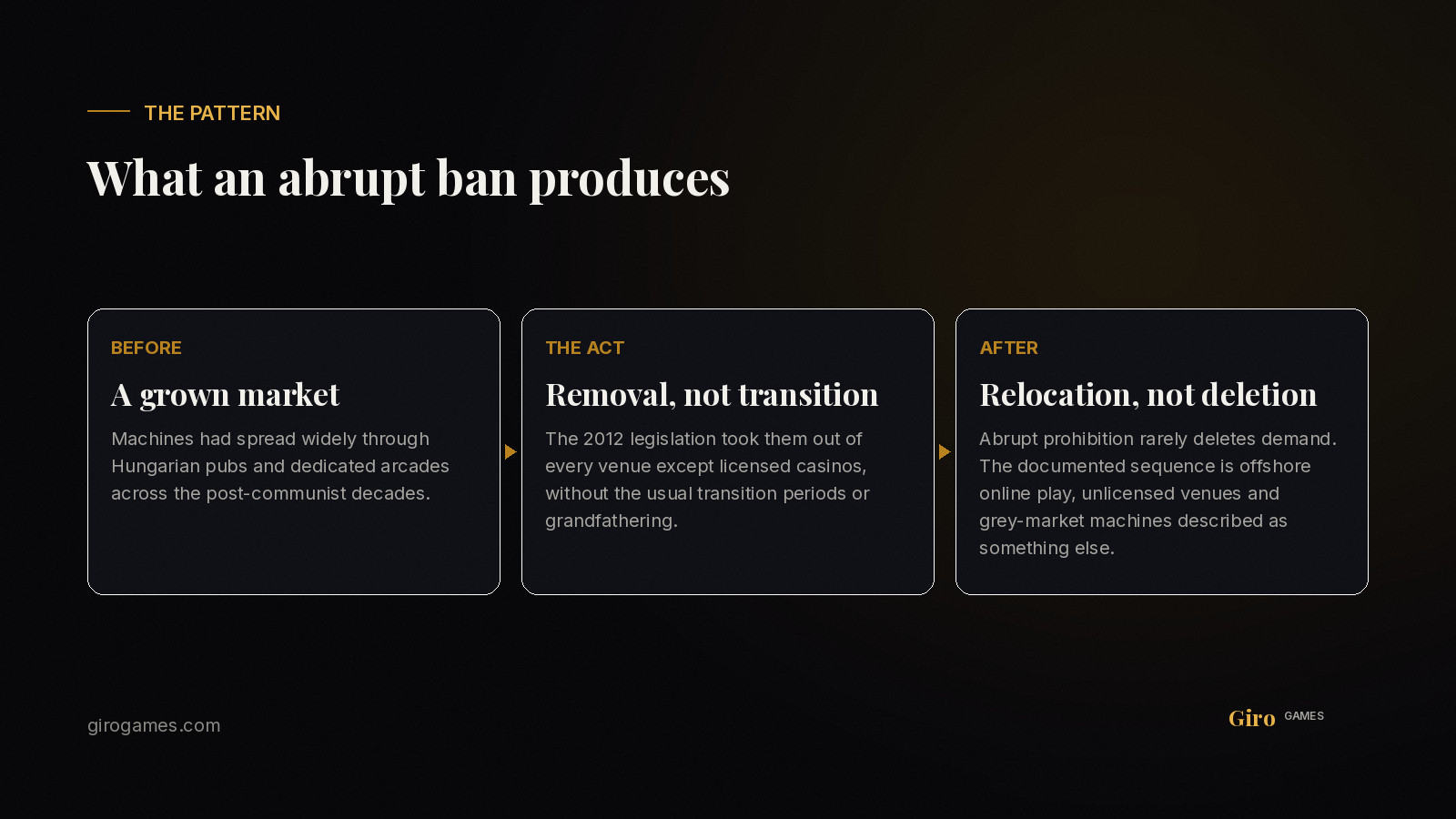
Slot machines had spread widely through Hungarian pubs and dedicated arcades in the post-communist decades. The 2012 legislation removed them from every venue except licensed casinos, of which there were very few. Thousands of machines and the businesses built around them were extinguished on an extremely short timetable. The government framed it as protection of the poor from a machine economy concentrated in low-income areas.
Operators framed it as expropriation. Hungarian and foreign investors argued they had made capital investments under licences and rules the state then abolished without compensation or adequate notice. Those claims travelled: cases concerning the Hungarian machine ban were filed at the European Court of Human Rights, and related questions were raised in EU legal fora over the treatment of investments and the free movement of services.
The regulatory dilemma the case exposes
Every gambling jurisdiction eventually faces a version of this. A market is licensed and grows. Harm concerns accumulate. The state wants to shrink the sector. And then a question arrives that has no comfortable answer: does a licence to operate create a protected expectation that the licence will continue?
Different countries answered differently in the same era. Italy chose gradual constriction through distance rules and reform packages. Norway removed private machines but built a state alternative, buffering the disruption. Hungary chose the cliff edge. Each approach trades legal exposure against speed of harm reduction, and Hungary’s case is the clearest illustration of what the fast option costs.
The part that always follows
Abrupt prohibition rarely deletes demand; it relocates it. Across the region, sudden machine bans have been followed by the same sequence — offshore online play, unlicensed venues, and grey-market machines described as something else. Germany is documenting exactly this pattern in the 2020s with the growth of illegal machines alongside its strict legal market; Russia and Ukraine each produced their own versions after their bans.
None of that argues against regulation. It argues that the design of the transition is itself a harm variable, and that a market removed without a licensed alternative tends to reconstitute somewhere less visible.
Why a studio reads court files
Because the durability of a market determines what is worth building for it. At Giro Games we build original slots for licensed online operators, and the licensing map is the first input to any commercial decision. Hungary is a reminder that a legal market is a political artefact, not a permanent feature of the landscape.
Sources: Laurus Invest Hungary KFT and Others v. Hungary, ECHR; Hungary bans slot machines to protect poor, NBC News.
18+. Play responsibly.