Giro Games
 Slot Machines Next to the Milk: Finland’s Supermarket Gambling Era
Most countries put slot machines somewhere you have to decide to go. Finland put them where you buy bread. For much of the late 20th and early 21st century, Finnish supermarkets, kiosks, petrol stations and ferry terminals hosted gaming machines operated by the state monopoly Veikkaus (and its predecessor RAY) — a density of everyday exposure that had few parallels anywhere in the world.
The logic that built it
The Finnish model rested on a bargain that Nordic countries made in different ways: gambling would be a state monopoly, and its proceeds would fund the public good — sport, culture, science, health charities. Under that framing, machines in grocery stores were not a moral problem but a distribution network. The revenue was visible, the beneficiaries were named, and the machines were as normal a piece of Finnish retail furniture as the deposit-bottle recycler.
Finland even had its own indigenous machine tradition to draw on: the pajatso, a coin-drop skill-ish device of the mid-20th century that became a cultural icon in its own right, distinct from the reel slots that followed it.
The reversal
By the late 2010s, the arithmetic of everyday exposure had become politically indefensible. Journalism and research on Finnish machine harm — including reporting on people who first encountered machines as children in shops — moved the debate. Veikkaus announced it would remove thousands of machines, cut marketing sharply, and — the structural change — require mandatory identification on machine play, so that every spin is tied to a person with limits rather than to an anonymous coin slot.
The fleet has been shrinking since. Finland then went further and dismantled the monopoly framing itself, opening a licensed market with a licensing window for private operators — a rewrite of the Nordic bargain that would have been unthinkable a generation earlier.
What the Finnish case actually demonstrates
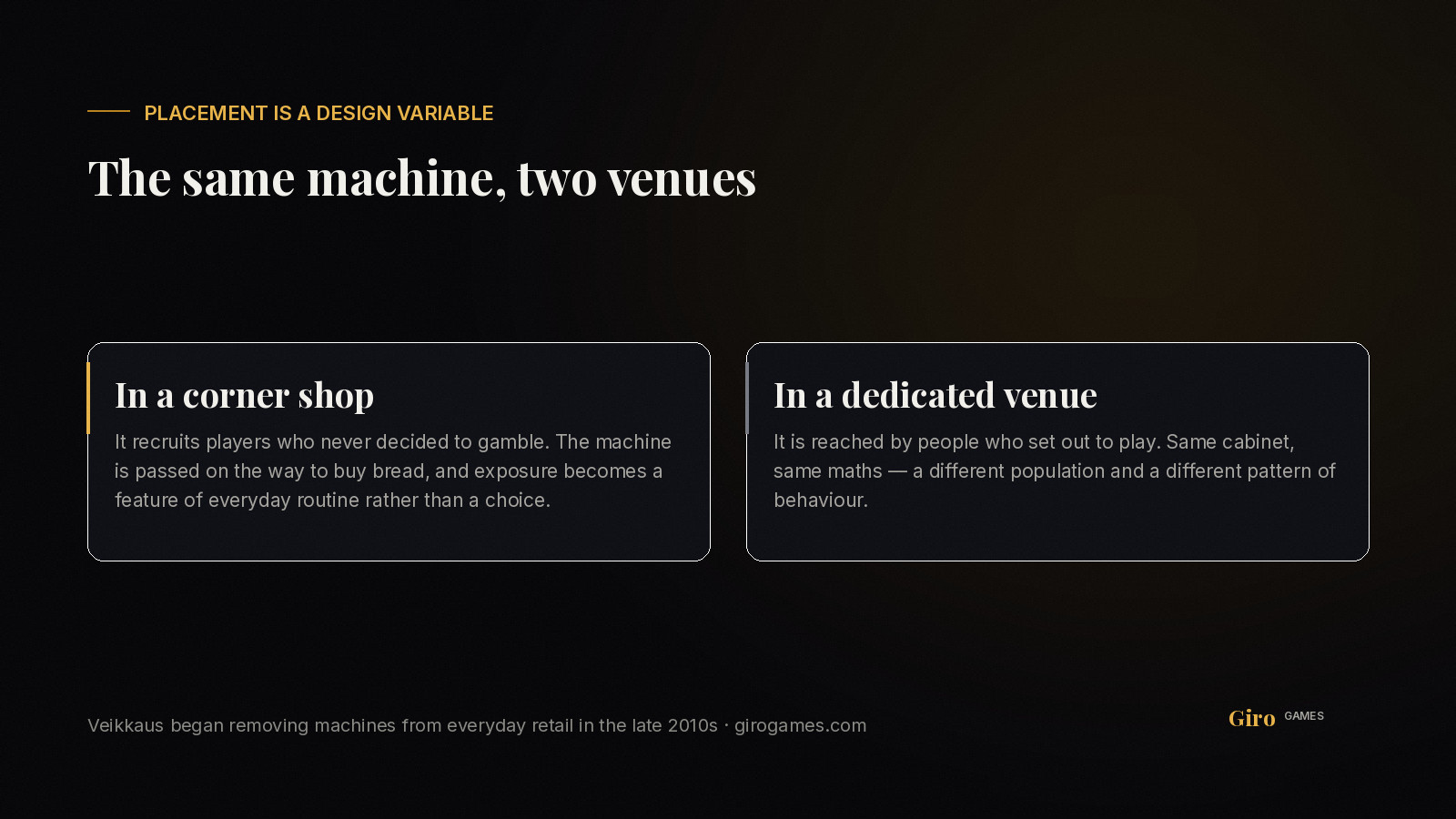
Two things, both uncomfortable for simple positions. First: placement is a design variable. The same machine in a dedicated venue and in a corner shop produces very different behaviour, because the second one recruits players who never decided to gamble that day. Second: identification changes the product more than the fleet size does. Halving the number of machines reduces opportunity; requiring ID changes what the machine is — from an anonymous device into an account with a memory.
Sweden, Norway and Iceland each ran variants of this experiment, which is why Nordic gambling policy is such a rich seam for anyone thinking about machine design. The region tested, in public, the questions the rest of the industry usually argues about in theory.
The view from a studio
Online slots inherit the Finnish lesson by default: on a licensed site, a player is always identified, and always has limits available. The design consequence is that a modern online slot is never really an anonymous machine — and building one as if it were is a category error. At Giro Games we design titles that expect that account layer to be there, the same way we expect an RTP baseline of 96%+ to be published rather than hidden.
Sources: Veikkaus to remove slot machines, cut marketing, Yle; The hidden victims of Finland’s slot machine culture, Yle.
18+. Play responsibly.