Giro Games
 Norway Switched Off Every Slot Machine in the Country. Then Measured What Happened
Countries rarely run controlled experiments on their own gambling markets. Norway effectively did — twice, in opposite directions, within four years — and the resulting data is one of the most interesting things in the study of gaming machines. Almost none of it is discussed outside Scandinavian research circles.
The switch-off
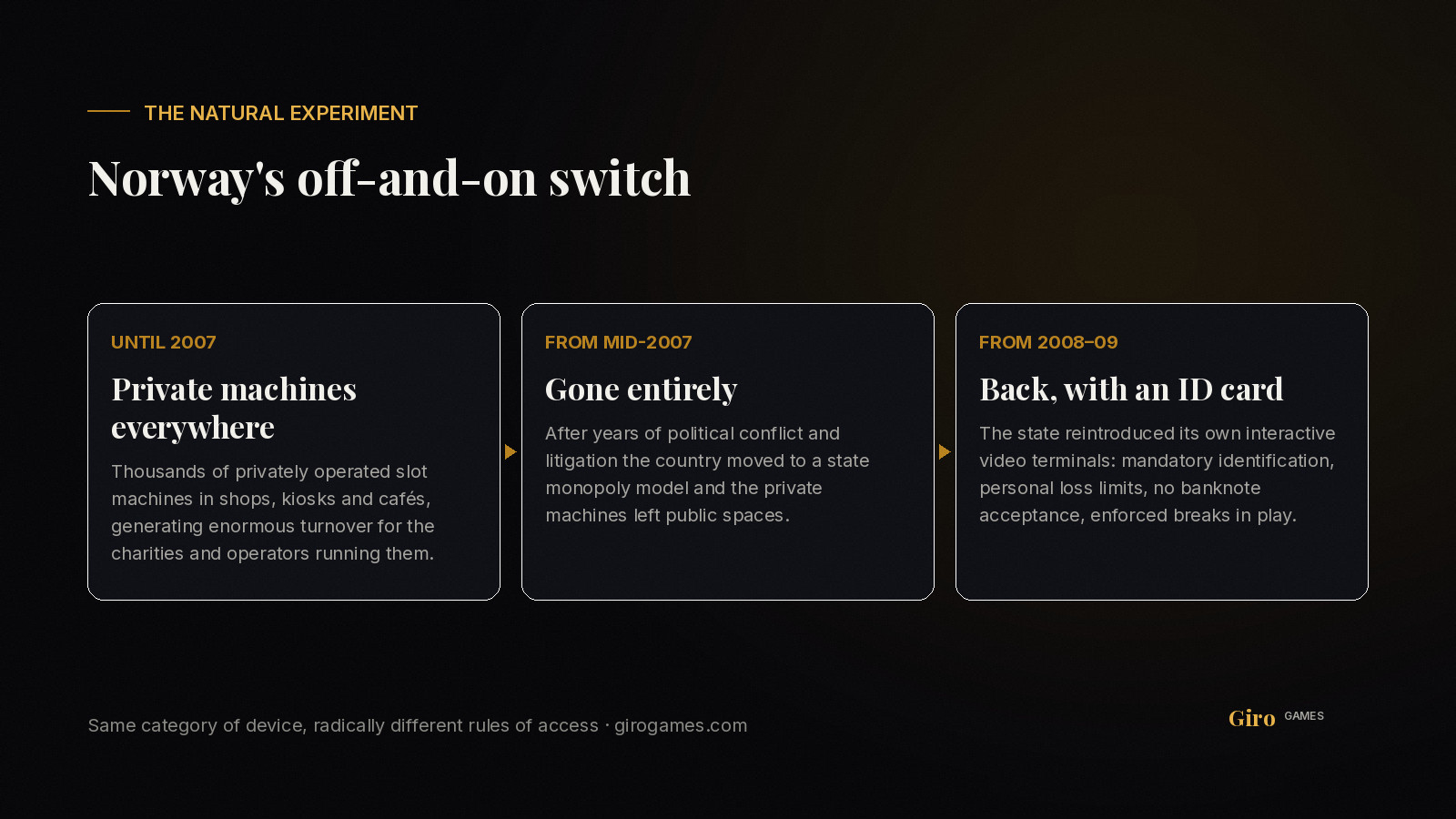
Until the mid-2000s Norway had thousands of privately operated slot machines in shops, kiosks and cafés, generating enormous turnover for the charities and operators that ran them. Following years of political conflict and litigation, the machines were removed: the country moved to a state monopoly model under Norsk Tipping, and by mid-2007 the privately operated machines were gone from Norwegian public spaces entirely.
Then, from 2008–2009, the state reintroduced its own machines — interactive video terminals, the Multix, deployed under monopoly control. Crucially, these terminals came with conditions private machines never had: mandatory player identification, personal loss limits, no banknote acceptance, and enforced breaks in play.
Why researchers care
Because Norway created something close to an on/off switch on a national machine market, with population-level survey data on either side. Studies of the period examined how gambling participation, expenditure and problem-gambling indicators moved when the machines vanished and when regulated substitutes returned. The design of the natural experiment — total removal, then controlled reintroduction — is the reason Norwegian data keeps appearing in international policy debates, including in Australian parliamentary research on electronic gaming machines.
The reintroduction is arguably the more interesting half. It tested a specific hypothesis: that the harm profile of a gaming machine is not fixed by the machine, but by the account layer wrapped around it. Same category of device, radically different rules of access.
The player card as a design surface
Mandatory identification changes what a machine is. Once every session is tied to an identity with limits, the terminal is no longer an anonymous coin-operated box; it is a client of a personal account with a policy attached. Norway pushed this further than almost anyone, and the Nordic neighbours followed at their own pace — Finland spent the 2020s attaching identification to its own ubiquitous machines and cutting their number.
For anyone who designs games rather than policy, this is a useful reframing. The historical craft of slot design assumed anonymity and continuous play. The Nordic model assumes neither. Games built for that environment optimise for something different: sessions that feel complete rather than endless, and features that resolve inside a limited budget.
Where our own work sits
Giro Games builds online titles for licensed operators, where account-level controls are already the norm — deposit limits, session reminders, self-exclusion. The Norwegian experiment is a reminder that those controls are not an afterthought bolted onto a game. They are part of the machine, and the good version of our craft designs with them rather than around them.
Sources: Regulatory Measures’ Effect on Gambling Participation: Experiences From Norway, Frontiers in Psychiatry; Electronic gaming machines: what lessons from Norway?, Parliament of Australia.
18+. Play responsibly.