Giro Games
 Setting 1 to 6: The Japanese Slot Machine With a Dial Inside
Here is a fact that quietly breaks the western mental model of a slot machine: in Japan, the same cabinet, running the same software, can be a different game on Tuesday than it was on Monday — because someone opened it with a key and turned a dial.
The settei system
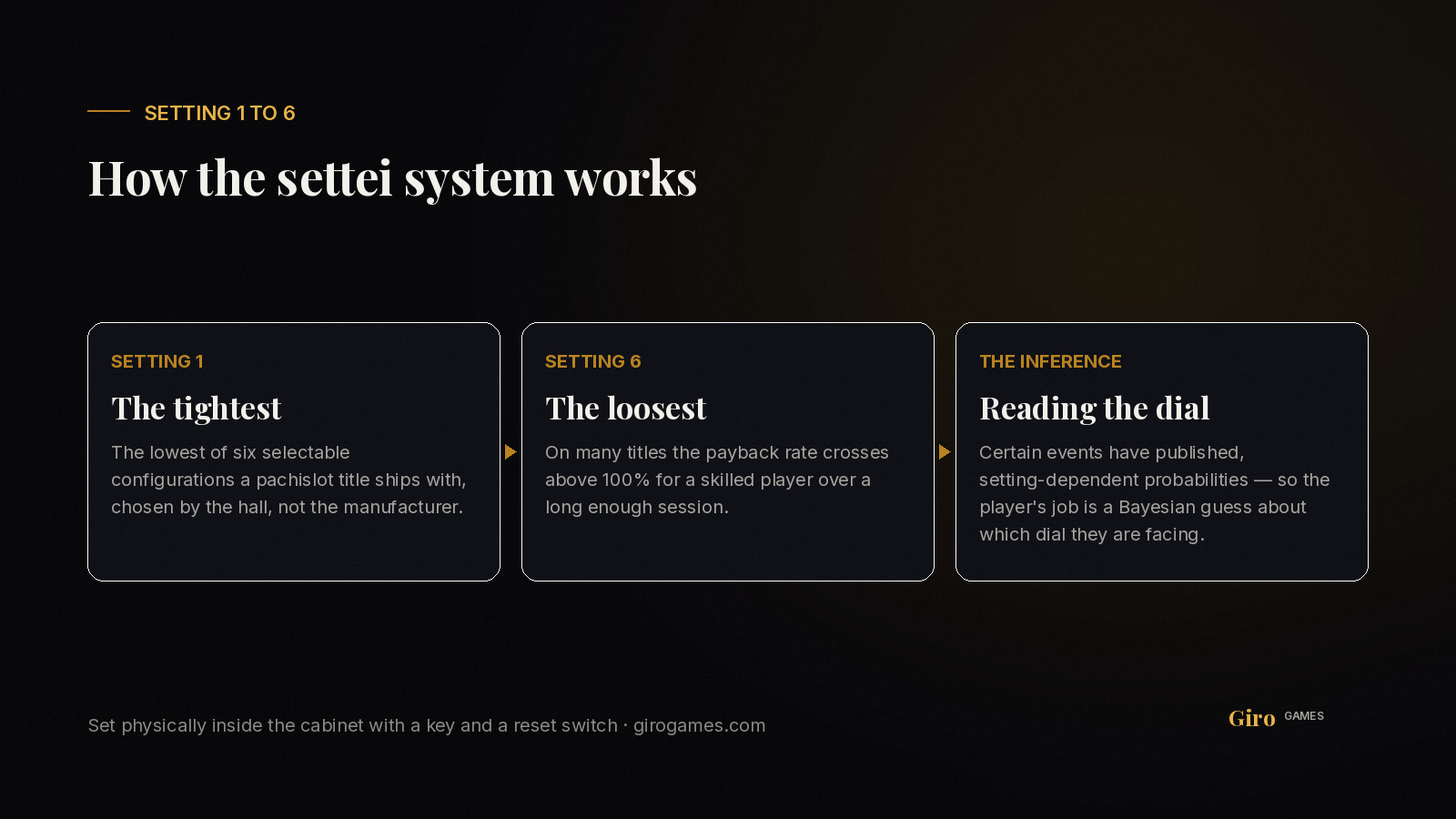
Japanese pachislot machines ship with six selectable configurations, known as settei (設定) 1 through 6. The hall operator sets the value physically, inside the cabinet, using a key and a reset switch. Setting 1 is the tightest; setting 6 is the loosest, with a payback rate that on many titles crosses above 100% for a skilled player over a long session. The player cannot query the setting. The machine will not tell them. The entire daily drama of a Japanese hall is built on that asymmetry.
Kikaiwari (機械割) refers to a payout or return rate, not the operator’s plan for distributing settings across the hall (National Diet Library reference record). A hall might place a handful of high-setting machines on a particular row, on a particular day, for a particular event, and let the crowd hunt for them. Regulars respond with settei-yomi: setting-reading. They count small bonuses, watch specific reel behaviours, track the frequency of rare in-game “tells” that appear at different rates per setting, and use those observations to build a Bayesian guess about which dial position they are sitting in front of.
Why this exists at all
Japanese pachislot occupies an unusual legal space — it is not classified as gambling in the western sense, and its economics run through a chain of prize exchange rather than direct cash payout. Within that frame, the settei system does something clever: it turns the hall itself into part of the game. A hall competes for regulars by how honestly it deploys high settings, and its reputation is a real asset. Player communities publish hall data. Some Japanese sites track the historical payout of individual machine seats by number.
Compare that with an RNG slot in a European online casino, where the RTP is fixed by the studio and identical for every player on the planet who opens the game. Japan built the opposite architecture: same software, variable generosity, hidden from the player, disclosed only through inference.
Reading a machine as an epistemic exercise
What makes settei-reading fascinating is that it is a genuine inference problem, not a superstition. Certain events in a pachislot title have published, setting-dependent probabilities — a specific bonus type, a rare sound cue, a particular character appearance. Observing enough of them shifts the posterior. Skilled players are effectively running hypothesis tests on a slot machine over thousands of spins, and the good ones are right more often than chance.
That is a strange and beautiful thing to build: a gambling machine whose most engaging layer is statistical detective work about the machine’s own configuration.
The design lesson
Every slot studio wrestles with the same tension — the math is hidden, but the player needs to feel that something knowable is happening. Japan resolved it by making the hidden variable discoverable in principle. At Giro Games our answer is transparency instead: one fixed math model per title, an RTP baseline of 96%+, published on the game page. Different philosophy, same underlying respect for the player’s desire to understand the machine in front of them.
Background: Pachislo Market — machine settings; Japanese community documentation of per-setting probabilities.
18+. Play responsibly.